

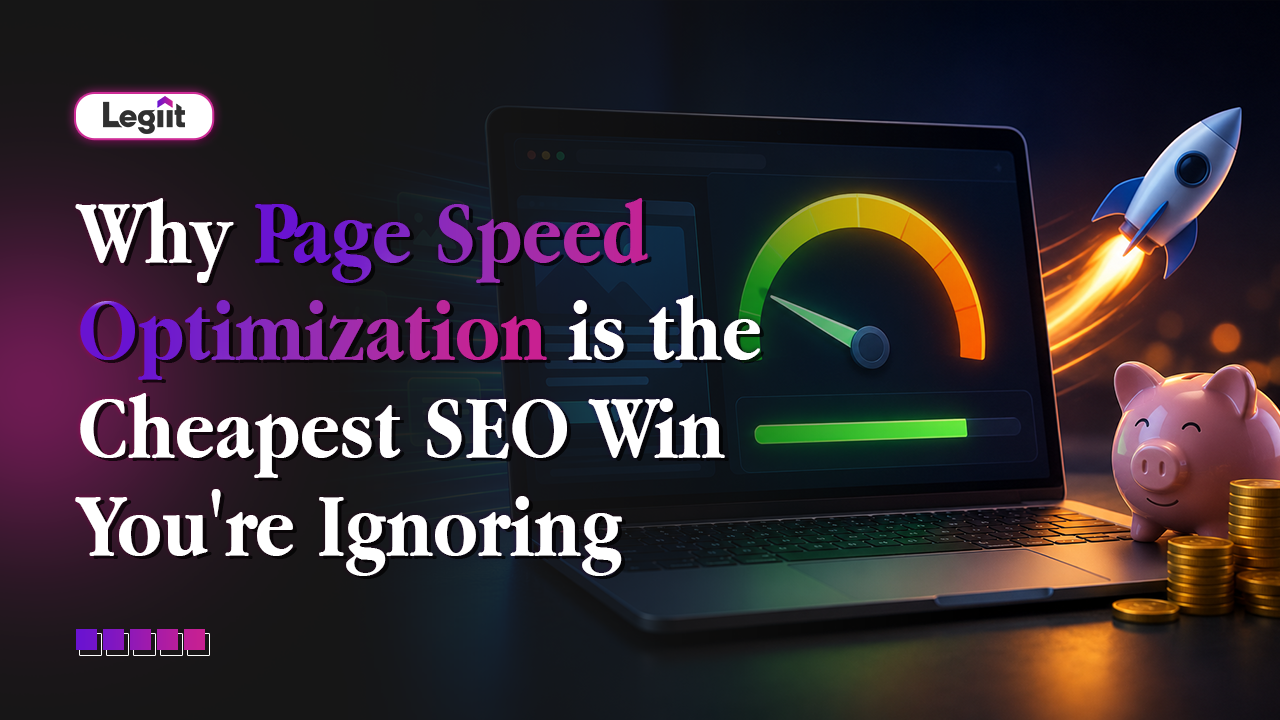
In the hyper-competitive search landscape of 2026, most business owners are obsessed with "more."
More backlinks, more 2,000-word blog posts, and more social media shouting.
While those strategies have their place, many are ignoring a "leak" in their sales funnel that is costing them thousands of dollars every month.
That leak is Page Speed.
Optimising your site's performance is often a one-time technical fix that provides a permanent boost to both your rankings and your revenue.
It is arguably the highest-ROI investment you can make because it fixes the foundation of your entire digital presence.
The Brutal Reality of the "100ms Rule"
In 2026, user patience is at an all-time low.
We live in an era of instant gratification, and your customers will not wait for a spinning loading icon.
Data from recent retail studies shows that even a 100-millisecond delay in load time can cause conversion rates to drop by up to 7%.
If your website takes 3 seconds to load instead of 1 second, you could be losing over 20% of your potential customers before they even see your offer.
Mobile Users are the Most Ruthless
Since most of your traffic comes from mobile devices, speed isn't just a luxury; it’s a requirement for survival.
Statistics show that 53% of mobile users will abandon a site if it takes longer than 3 seconds to load.
For local service businesses, like a moving company in Manchester or an electrician in Charlotte, a slow site is a direct donation to your faster competitors.
Interaction to Next Paint (INP): The New Ranking Gold Standard
Google’s algorithm has evolved significantly, and in 2026, the focus has shifted toward Interactivity.
The latest Core Web Vitals, Interaction to Next Paint (INP), is now a primary ranking factor.
INP measures how quickly your page responds to a user's very first action, such as clicking a button or typing in a contact form.
| Metric | What it Measures | 2026 Target |
|---|---|---|
| LCP (Largest Contentful Paint) | Visual Loading Speed | Under 2.5 Seconds |
| CLS (Cumulative Layout Shift) | Visual Stability | Under 0.1 |
| INP (Interaction to Next Paint) | User Responsiveness | Under 200 Milliseconds |
The SEO Advantage of Speed

Sites that pass all Core Web Vitals (LCP, CLS, and INP) receive a significant "tie-breaker" boost in the search results.
When Google sees two pages with similar content and authority, it will always prefer the one that provides a superior user experience.
Faster pages also lead to higher Dwell Time, signalling to search engines that your content is high-quality and relevant.
The "No-Code" Performance Trap
Many small businesses in 2026 rely on popular no-code builders like Wix, Squarespace, or heavy WordPress themes using Elementor.
While these tools are great for design, they often suffer from Code Bloat.
These "Franken-stacks" load massive, unnecessary background scripts and CSS files that the user never actually sees.
This results in a "heavy" website that struggles to reach a 100/100 score on Google PageSpeed Insights.
The Developer Edge

Hiring a freelance developer specialising in technical SEO to clean up these scripts or switch to a "Headless" setup can result in a performance leap that a generic builder cannot reach.
A lean, custom-optimised site requires less hosting power and fewer "performance-fix" plugins, saving you money on monthly overhead.
By stripping away the junk, you ensure that your site is built for speed from the ground up.
Actionable "Quick Wins" for 2026
You don't always need a full rebuild to see massive improvements in your load times.
Here are four technical "Quick Wins" that can move the needle for your site this week:
- Next-Gen Images: Convert all your JPGs and PNGs to WebP or AVIF formats. This can reduce file sizes by up to 80% without any loss in visual quality.
- Critical CSS: Inline your most important styles so the "above the fold" section renders instantly while the rest of the site loads in the background.
- Server-Side Caching: Use a high-performance Content Delivery Network (CDN) like Cloudflare to serve your site from a server physically closer to your user.
- Minify and Defer: Shrink your JavaScript and CSS files and "defer" non-essential scripts so they don't block the initial page render.
Why Speed Optimisation is a One-Time Cost with Lifetime Benefits
Unlike content marketing or link building, which require ongoing monthly retainers, speed optimisation is often a technical "set it and forget it" task.
Once your images are compressed, your scripts are minified, and your caching is configured, those benefits stay with your site forever.
It is the "cheapest" win because it improves the performance of every other SEO and marketing dollar you spend.
Your paid ads will convert better, your organic traffic will stay longer, and your brand trust will increase.
On Legiit, business owners are increasingly utilising the page speed optimisation subcategory to find specialised experts who can fix these technical bottlenecks in 48 hours or less.
Frequently Asked Questions
Q: Is my hosting provider responsible for my page speed?
A: Only partially. While a fast server is important, most speed issues are "on-page" problems, such as unoptimized images, heavy plugins, and messy code.
Q: Will a 100/100 PageSpeed score guarantee I rank #1?
A: No, but it is a powerful ranking signal. Think of speed as the "entry fee" for the first page; without it, even great content will struggle to compete.
Q: Do I need to be a coder to optimise my page speed?
A: Some basic things can be done via plugins (like WP Rocket), but for true "Elite" performance, you usually need a Freelance Developer to handle the deeper technical fixes.
Q: How often should I check my site speed?
A: You should run a check once a month or whenever you add a new plugin or a large batch of images to your site. Speed can "decay" as you add more content.
Q: What is the best tool to measure my speed in 2026?
A: Google PageSpeed Insights and GTMetrix remain the gold standards, but make sure you are specifically looking at the Mobile tab, as that is what Google uses for indexing.
The Strategic Bottom Line
In 2026, a slow website is a broken website.
You can spend thousands on the world's best content, but if your page takes 5 seconds to load, your target audience will never see it.
Page speed optimisation is the ultimate "low-hanging fruit" of digital growth, a technical fix that pays dividends in rankings, trust, and hard sales.
Stop ignoring the foundation of your funnel.
By hiring a vetted expert from the Page Speed services on Legiit, you can plug the leaks in your site and start outperforming your slower competitors today.








 Download