

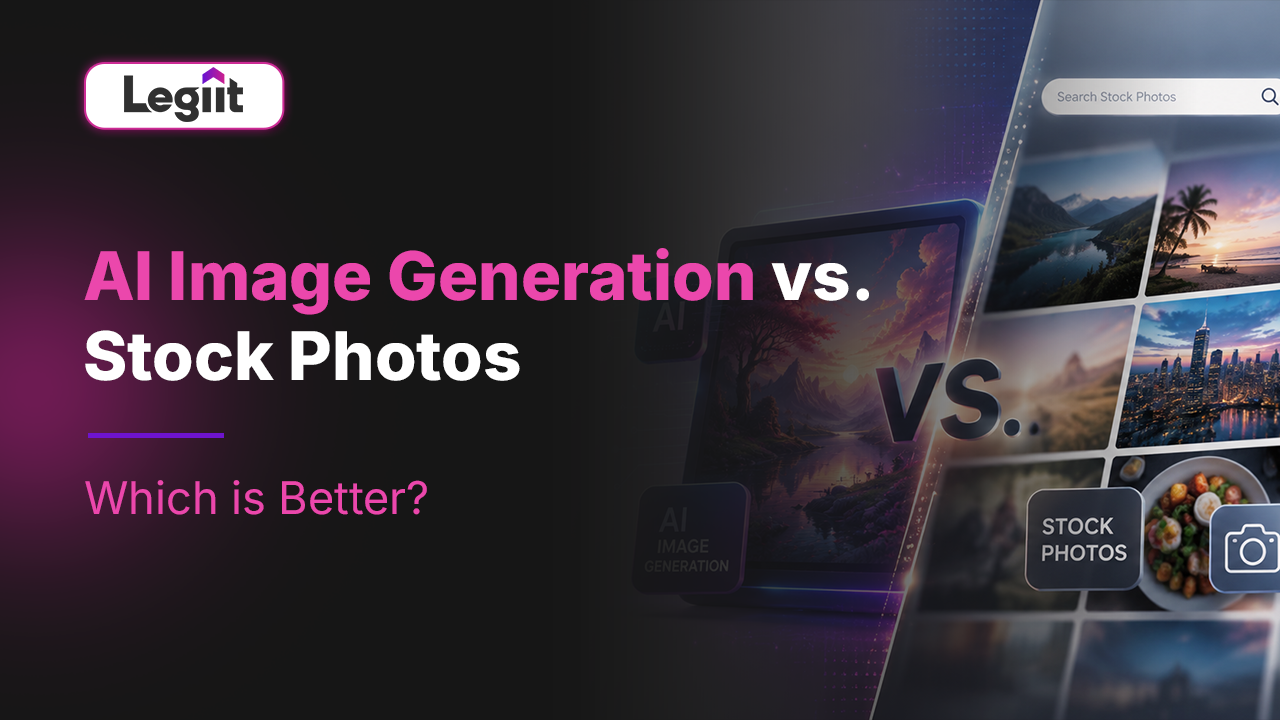
For decades, marketing had a familiar rhythm. You needed an image for a campaign, so you went to a stock photo site. You typed in "business meeting," scrolled through pages of people in ill-fitting suits shaking hands, and paid $20 for a photo that five of your competitors were already using.
It was boring, but it worked.
Then came AI. Suddenly, you could type "business meeting on Mars" and get a result in seconds. It was exciting, fast, and incredibly cheap. But it also brought new problems: weird fingers, plastic-looking skin, and legal confusion.
Now, in 2026, the debate is no longer about "which is cool." It is about "which makes money." E-commerce brands are ditching stock subscriptions in droves, but smart creative directors know that AI isn't a magic bullet for everything.
This guide breaks down the pros, cons, and bottom line value of both options to help you decide which tool is right for your business.
The Stock Photo Struggle: Expensive and Everywhere

Stock photography has been the backbone of the internet for twenty years. Its biggest strength is realism. When you download a photo from Getty or Shutterstock, you know the people are real, the lighting is physically accurate, and the hands definitely have five fingers.
However, stock photography suffers from two fatal flaws in the modern market:
- 1. The "Stock Photo Dave" Problem: There is a limited pool of high-quality models. We have all seen that one "distracted boyfriend" meme guy or the "smiling senior with tablet." When you use stock photos, you risk using the same face as a pharmaceutical ad or a sketchy crypto scam. It dilutes your brand authority.
- 2. The Inflexibility Tax: If you find a near-perfect photo but the model is wearing a blue shirt instead of your brand's red, you are stuck. You either spend hours in Photoshop or you settle for "good enough." In e-commerce, "good enough" usually means lower conversion rates.
The AI Advantage: Infinite Customisation
AI image generation (using tools like Midjourney, Flux, or Stable Diffusion) offers the exact opposite proposition. It trades "guaranteed realism" for infinite control.
- Cost Efficiency: A high-quality stock photo license can cost anywhere from $10 to $500 for commercial use. An AI generated image costs fractions of a cent in computing power. For a brand that needs 50 social media posts a month, the savings are massive.
- Brand Specificity: This is the killer feature. With AI, you don't search for an image; you build it. Need a model holding your specific product? AI can do that (with the right training). Need the background to match your Q3 marketing colour palette exactly? AI can do that instantly. Need to turn a daytime shot into a night scene without reshooting? Done in seconds.
The "Uncanny Valley" and Why Stock Still Survives
So, is stock photography dead? Not quite.
AI still struggles with "authenticity." In 2026, audiences are very good at spotting the "glossy" look of AI. If you are a news organisation, a documentary filmmaker, or a brand that relies on raw, gritty honesty, AI can feel fake.
Stock photos, especially candid, user-generated style shots, still win on trust. If you are selling a weight loss supplement, people want to see a real person, not a digitally generated avatar. Using AI there can actually hurt your sales because it feels deceptive.
The New Winner: Hybrid Workflows
The smartest brands aren't choosing one or the other. They are combining them.
They might buy a stock photo of a real street scene to get the authentic lighting and texture. Then, they use AI "Inpainting" to swap out the billboard in the background with their own ad, or to change the model's clothing to match their latest collection.
This Hybrid Approach gives you the realism of photography with the flexibility of AI. However, executing this requires skill. You can't just push a button; you need an artist who knows how to blend these layers seamlessly.
This is why the demand for specialised image experts is exploding. You don't need a photographer to fly to Paris anymore, but you do need a freelancer who knows how to use AI to make it look like they flew to Paris.
Final Verdict
Who should use Stock Photos? Journalists, medical professionals, and brands where "Truth" is the product. If your audience requires absolute proof of reality (e.g., "Before and After" results), stick to cameras.
Who should use AI Image Generation? E-commerce brands, creative agencies, and content marketers. If you need to stop the scroll, save money, and match a specific aesthetic, AI is vastly superior.
The battle is effectively over for marketing visuals: AI wins on speed, cost, and creativity. But the tool is only as good as the user. A bad prompt gives you a bad image.
To get the full benefit of AI without the "plastic" look, you shouldn't just sign up for a tool; you should hire an expert to build your visual pipeline. The freelancers listed in our Top 7 Guide are the bridge between "cheap AI" and "professional brand assets."
FAQ: AI vs. Stock Images
Is AI cheaper than stock photos?
Yes, overwhelmingly so. A subscription to an AI tool like Midjourney might cost $30/month for unlimited images, whereas a single premium stock photo license can cost that much. Over a year, AI can save a marketing team thousands of dollars.
Can I copyright AI-generated images?
Generally, no. In the US and many other regions, you cannot copyright an image created entirely by a machine. However, if you use a Hybrid Approach, where a human artist significantly edits, paints over, or modifies the AI generation, that final work can often be protected.
Do AI images still look fake in 2026?
It depends on the skill of the creator. "Raw" AI output often looks too smooth or plastic. However, images created by expert freelancers who use "LoRA" models and post-processing tools are often indistinguishable from professional photography.
Which is faster for deadlines?
AI is faster if you need something specific (e.g., "a cat wearing sunglasses on a skateboard"). Finding that exact image in a stock library could take hours of searching. However, if you just need "generic office team," stock is faster because you just download it and go.






 Download