

Here is a hard truth about modern marketing: Everyone is using the same map.
Your competitors are using the same SEO tools you are. They are looking at the same keyword lists. They are tracking the same rankings. If you are all staring at the same data, you are all going to come to the same conclusions.
You end up fighting a bloody battle for the same ten keywords, driving up costs and driving down results.
But what if you could see the opportunities that aren't on their map?
This is where AI-Driven Opportunity Detection changes the game. While traditional tools tell you what is happening now, AI tells you what is missing. It finds the "Blue Oceans", the quiet, profitable gaps in the market, that standard keyword research completely ignores.
Here is how to use AI to find the gold mines your competitors are walking right past.
Why Traditional SEO Misses the Mark
The problem with traditional SEO isn't that it's wrong; it's that it is reactive.
Old-school analysis looks at historical data. It tells you, "Competitor A ranks for 'Best Running Shoes'." So, you try to write a better article about running shoes. You are constantly playing catch-up, reacting to moves your competitors made six months ago.
It focuses on Keywords (what people type), not Context (what people actually want). It sees a gap in volume, but it misses the massive gaps in value.
How AI "Sees" Opportunities Differently
AI doesn't just read data; it reads patterns.
Think of traditional SEO like using a metal detector on a beach. You only find what is directly under your feet. AI is like a satellite scan. It sees the entire landscape, the currents, and the geology.
It analyzes millions of search queries to understand the "Semantic Web", the hidden connections between topics. It notices when users are searching for an answer but clicking "Back" because no result satisfies them. It identifies frustration. And in business, frustration equals opportunity.
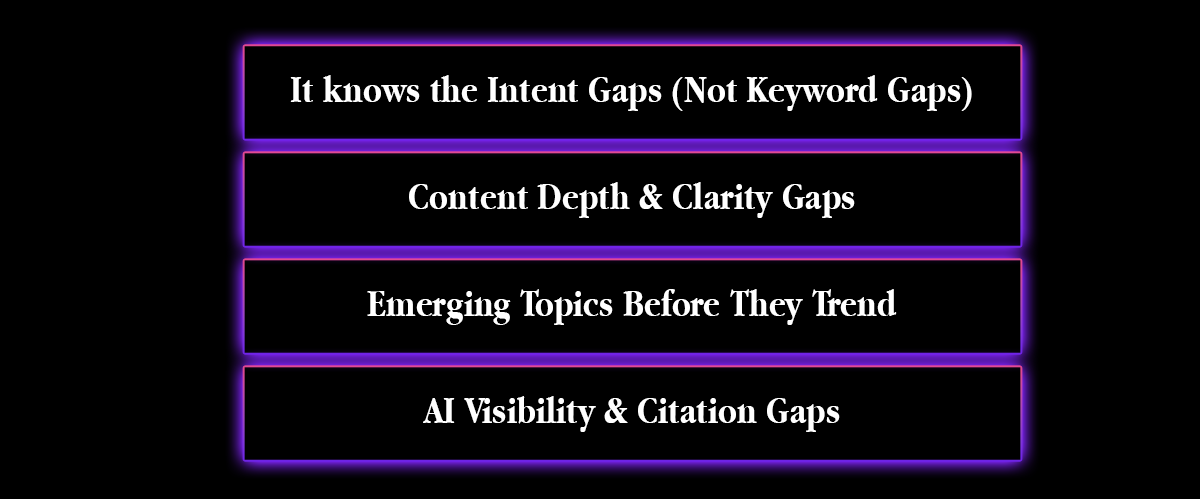
Here are the four specific types of gaps AI can find for you.
Opportunity #1: Intent Gaps (Not Keyword Gaps)
Most businesses obsess over "Keyword Gaps." "My competitor ranks for 'CRM software' and I don't."
AI looks for Intent Gaps.
It notes that while 10,000 people search for "CRM software," 40% of them immediately refine their search to "CRM for one-person business."
If your competitors are all writing generic guides on "What is a CRM," the AI identifies a massive opportunity to write a specific guide for solopreneurs. The keyword volume might be lower, but the intent is laser-focused. You stop fighting for the generic traffic and capture the buyers the giants are ignoring.
Opportunity #2: Content Depth & Clarity Gaps
Have you ever read a top-ranking article that was long, boring, and hard to read?
AI spots this instantly. It analyzes the "Information Gain" of the top results. It might tell you: "The top 3 results for this topic are all 10 years old and difficult to read. They lack examples and data."
This is a Clarity Gap.
You don't need a new keyword. You just need to cover the same topic but make it 50% easier to read or update it with 2026 data. AI tools can score your content against competitors not just on keywords, but on readability and comprehensiveness.
Opportunity #3: Emerging Topics Before They Trend
Traditional tools show you trends after they happen. AI tools are Predictive.
By analyzing discussions on forums, social media, and niche communities, AI can spot a rising topic before it hits the mainstream keyword tools.
For example, before "AI Overviews" became a buzzword, AI analysis tools saw a spike in users asking about "Google SGE snapshots." If you wrote about it then, you would have owned the topic before your competitors even knew it existed. AI gives you the "First Mover Advantage."
Opportunity #4: AI Visibility & Citation Gaps
This is the newest and most critical opportunity.
Very few people are tracking this. Your competitor might rank #1 in the blue links, but who is the AI citing in the Overview?
Often, it’s not the #1 result. It’s the site with the clearest structure and the best schema markup.
AI tools can now analyze the "Snapshot" results to see which sources are being used. If you see that the AI is struggling to find a good answer, or citing a weak source, that is a Visibility Gap. You can swoop in, optimize your content structure (using lists and direct answers), and steal that citation spot, even if you don't beat the competitor in the traditional rankings.
How to Turn AI Insights Into Action (The Execution Layer)

Finding the gap is only step one. Filling it is how you make money.
- Stop Copying: If the AI says everyone is covering "Topic A" the same way, do the opposite. Add a personal story, a video, or original research.
- Optimize for "Extractability": Reformat your content so the AI can easily read it. Use bullet points for the gaps you found.
- Update Old Content: Use AI to scan your library and identify which posts have "decayed" compared to the current market standard.
- Target the "Long Tail": Use AI to find those hyper-specific questions (4+ words) that have zero competition but high purchase intent.
Final Verdict
The era of "lazy SEO" is over. You can no longer just look at a keyword difficulty score and write a blog post.
To win in 2026, you need to see what others miss. You need to find the frustrated users, the unanswered questions, and the boring content that you can improve.
AI is your radar for these opportunities. It clears the fog of war and shows you exactly where the open ground is.
But interpreting this data, understanding "semantic gaps" and "entity voids", is a skill in itself.
You don't have to become a data scientist to benefit from this. Some experts specialise in this specific type of analysis. Check out our guide on the Top 10 Freelancers for AI-Powered SEO Tools and Rank Tracking Software. These pros can run a "Gap Analysis" for you today, handing you a roadmap of opportunities your competitors haven't even noticed yet.
FAQ: Using AI for Competitor Analysis
Will AI tell me exactly what to write?
It will give you the topic and the angle, but you should write the story. AI is great at structure, but humans are better at connection and empathy.
Are these tools expensive?
Some predictive AI platforms are pricey. However, the ROI of finding a "Blue Ocean" keyword is massive. Alternatively, hiring a freelancer who has access to these tools is a cost-effective hack.
Can AI really predict trends?
It deals in probabilities, not certainties. It can say, "There is an 80% chance this topic will grow," which is far better than guessing.
What if my competitors start using AI too?
They will. But most will use it lazily, just to generate more generic text. If you use it strategically to find gaps and intent, you will stay ahead.







 Download