


We have all seen it happen. You spend weeks building or configuring an AI writing tool. You are excited to launch it. You type in your first prompt, expecting brilliance.
Instead, you get mediocrity. The content is repetitive. It hallucinates facts. It uses a tone that sounds nothing like your business.
The problem is rarely the AI model itself. GPT-4 and Claude are incredibly capable engines. The problem is almost always the "Quality Control" layer, or the lack thereof.
An AI model is like a high-speed sports car. If you do not put guardrails on the track (the rules), it will crash into the wall. To turn raw AI potential into a reliable business asset, you must implement a strict system of quality control. You need to teach the tool not just what to write, but exactly how to measure if it has done a good job.
This guide explores how to build a quality assurance layer into your AI workflow, ensuring that every piece of content it generates meets your professional standards.
The Foundation of Quality: Explicit Constraints
The biggest misconception about AI is that it "knows" what good content looks like. It does not. It only knows what average content looks like, based on the billions of web pages it has read.
To get "great" results, you must force the AI to follow specific rules. These are often called "Negative Constraints."
Most people tell the AI what to do: "Write a funny blog post about marketing."
Experts tell the AI what not to do: "Write a blog post about marketing. Do not use puns. Do not use the word 'delve.' Do not start sentences with 'In today's fast-paced world.' Ensure no paragraph exceeds three lines."
Quality control starts here. By defining the "Do Not" list, you instantly eliminate 50 per cent of the fluff that makes AI content sound robotic.
The Three Layers of AI Evaluation
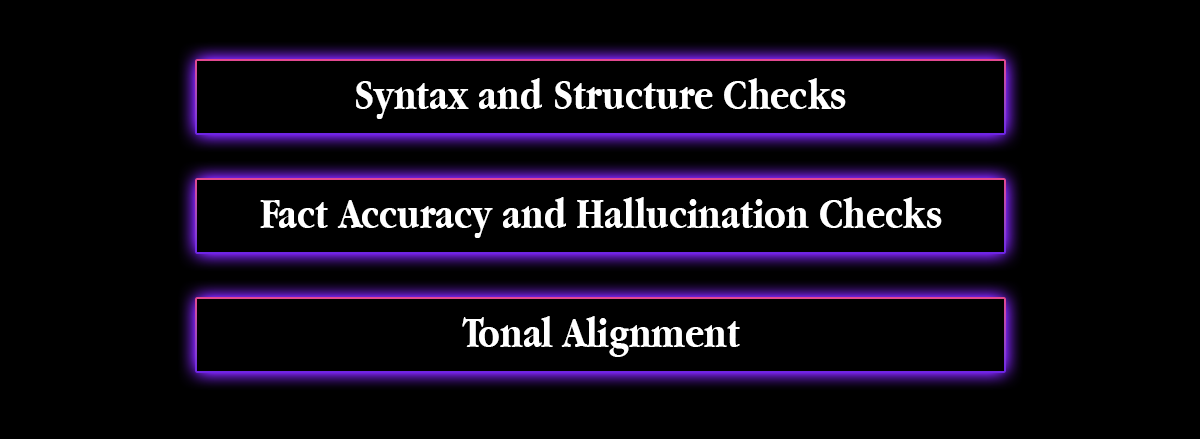
How do you know if the output is actually good? You cannot just glance at it. You need a systematic way to judge it. When building a tool, successful developers use a three-layer approach.
- 1. Syntax and Structure Checks: This is the most basic level. Does the content follow the formatting rules? If you asked for a 100-word LinkedIn post, did you write 300 words? If you asked for JSON format, did it give you plain text? Automated scripts can check this instantly. If the AI fails this test, the tool should automatically reject the output and try again without you ever seeing the error.
- 2. Fact Accuracy and Hallucination Checks: This is the danger zone. AI loves to invent statistics to make a point. Quality control here involves "Grounding." You must ensure your tool is connected to a reliable source of truth, such as your internal documents or a live search API. You then ask the system to cite its sources. If a claim has no citation, it gets flagged for human review.
- 3. Tonal Alignment: This is the hardest metric to automate. Does it sound like you? To measure this, you use "Reference Comparison." You feed the AI three examples of your best past writing and ask it to grade its new draft against them. "On a scale of 1 to 10, how closely does this new draft match the sarcasm and sentence length of the examples provided?" If the score is below an 8, the system regenerates the content automatically.
The Human in the Loop (HITL)

No matter how advanced your automated rules are, you cannot fully remove humans from the process. The goal of AI is not to replace the editor; it is to replace the drafter.
Your workflow should always adhere to the "30% Rule." The AI does 70 per cent of the work (research, structure, first draft). The human does the final 30 per cent (nuance, emotion, strategy).
A good custom content tool will have a "Review Interface" built in. It should highlight uncertain claims or weak sentences, drawing the human editor's eye exactly to the parts that need attention. This makes the review process take minutes instead of hours.
Why You Need an Architect, Not Just a Prompter
Setting up these quality control layers, negative constraints, automated grading, and hallucination checks is technical work. It requires more than just typing into ChatGPT. It requires understanding APIs, system prompts, and Python scripts.
If you try to "wing it," you will likely end up with a tool that works "sometimes." In business, "sometimes" is not good enough.
This is why we always recommend hiring a specialist. Some structural engineers specialise in building these exact safety nets. They know how to program the "rules" that keep the AI on track, ensuring you get a finished product that you can trust to safely scale your SEO or content marketing output.
FAQ: AI Quality Control
Q: How is AI used in quality control?
A: AI is used in quality control by acting as its own editor. You can set up a "Critic Agent", a separate AI prompt that reads the content generated by the "Writer Agent." The Critic looks for specific errors, tonal mismatches, or logical gaps and provides feedback to the Writer to fix them before the human ever sees the draft.
Q: What are the four steps involved in evaluating the quality of AI-generated content to ensure it meets professional standards?
A: The steps include:
1. Instruction Adherence: Did the AI follow the prompt exactly (length, format, topic)?
2. Factual Verification: Are the names, dates, and statistics accurate and cited?
3. Tonal Consistency: Does the writing match the brand voice and reading level required?
4. Originality Check: Is the content unique, or is it too close to existing generic templates?
Q: What do AI content tools need for high-quality outputs?
A: They need Context and Constraints. Context means giving the AI your brand history, audience data, and specific goals. Constraints mean giving the AI strict boundaries on what it is not allowed to do. Without these two elements, even the most powerful model will produce generic, low-quality work.
Q: How do you ensure responsible use of AI tools in your workflow?
A: You ensure responsibility by maintaining a Human in the Loop. Never let an AI tool publish content directly to your website or social media without a human reviewing it first. Additionally, be transparent with your audience when content is AI-assisted, and regularly audit your tool to ensure it is not outputting biased or harmful information.
Final Verdict
Quality control is the difference between an AI toy and an AI tool.
Anyone can get a chatbot to write a paragraph. But building a system that reliably produces high-quality, on-brand, and accurate content day after day requires strict rules and automated testing.
It is a complex build, but the payoff is massive. When you can trust your tool, you can scale your business. If your enterprise depends on strong technical standards, deploying a fully optimised framework through an AI marketplace is the best approach.
If you are ready to build a content engine that actually follows the rules, do not try to figure out the complex engineering alone. Check out the experts specialising in programming & technology on Legiit who can build these quality control systems for you, giving you a reliable asset that saves you time without sacrificing quality.









 Download