

We live in a subscription economy. If you need a solution, the default instinct is to buy a license. You need a CRM? You buy Salesforce. You need traffic data? You install Google Analytics. You need visualisations? You pay for Power BI.
For many companies, this works perfectly fine. If you run a standard ecommerce store or a simple blog, the standard metrics are exactly what you need.
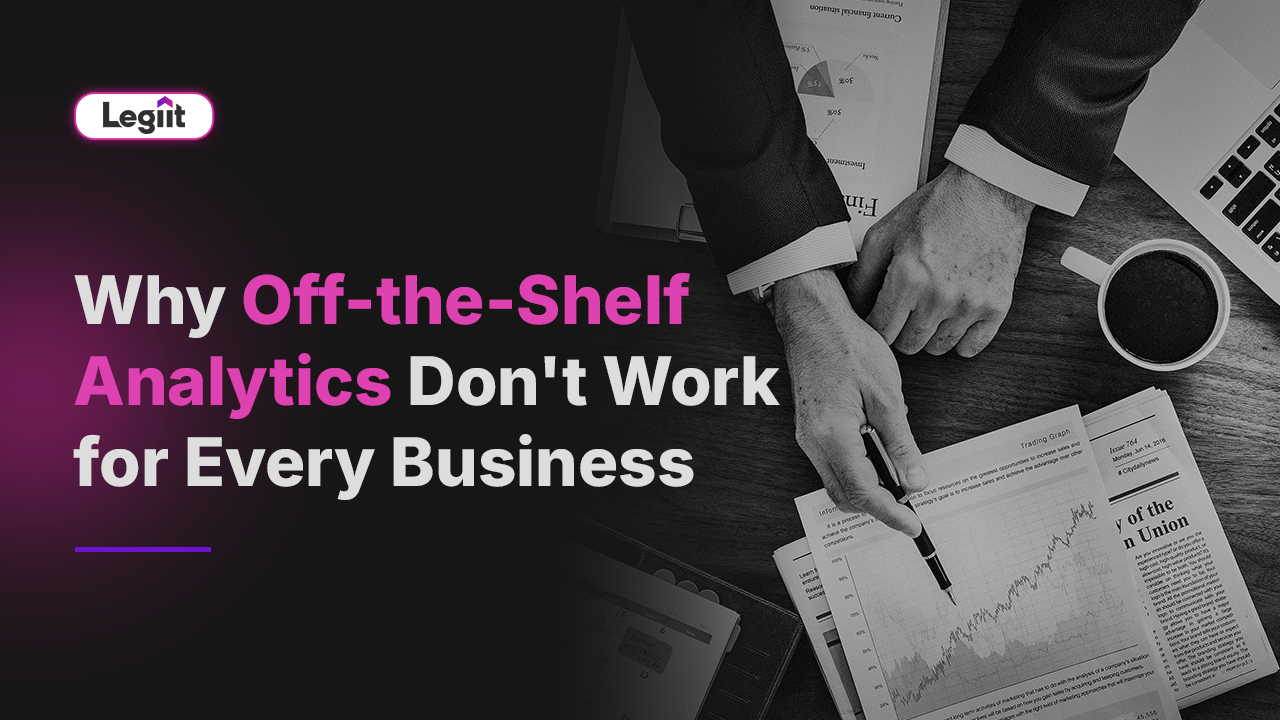
But there is a breaking point. As a business matures, its questions become more complex. You stop asking "How many visitors did we get?" and start asking "How does the weather in Chicago affect our inventory turnover for winter coats?"
This is where off-the-shelf analytics tools begin to fail. They are built for the average user, designed to satisfy the widest possible market. But your business is not average. It has unique logic, unique workflows, and unique data sources that a pre-packaged tool was never designed to handle.
This guide explores the hidden limitations of generic analytics platforms and why the most successful data-driven companies eventually build their own intelligence systems.
The Problem with the "Average User" Design

Software companies want to sell to everyone. To do that, they have to water down their product. They focus on universal metrics, page views, session duration, and click-through rates.
While these numbers are useful, they are often surface-level. They are "Vanity Metrics." They look good on a report, but they rarely drive high-level strategy.
If you run a complex subscription business, a standard dashboard might calculate "churn" based on when a user clicks cancel. But your business logic might define churn based on "30 days of inactivity." An off-the-shelf tool cannot easily adapt to your specific definition of failure or success. You end up fighting the software, exporting data into spreadsheets to recalculate the numbers yourself using the math that actually matters to your bottom line.
The Data Silo Nightmare
Modern businesses rarely run on a single platform. You might use Shopify for sales, HubSpot for marketing, Zendesk for support, and a legacy SQL database for warehouse inventory.
Off-the-shelf analytics tools usually offer "native integrations" for the biggest platforms. They connect easily to Facebook Ads or Google Sheets. But as soon as you try to connect something niche, custom, or legacy, the system breaks.
This creates data silos. Your marketing team sees ad spend in one dashboard. Your operations team sees inventory levels in another. Because these tools do not talk to each other, you cannot see the critical correlation between them. You cannot easily see if a specific ad campaign is driving returns (not just sales) because the ad tool cannot read the return data from the warehouse tool.
Custom analytics solutions solve this by building specific "pipelines." They do not care where the data comes from. A developer can write a script to pull data from anywhere, even an ancient server in your basement, and merge it into a single source of truth.
The "Black Box" Algorithm Risk
When you use a proprietary platform like Google Analytics 4 or a social media insights tool, you do not own the logic. You are renting their math.
If the platform decides to change how they calculate "Engagement Rate" or "Attribution," your historical data changes overnight. You have no control over it. You might think your marketing is improving, but really, the tool just changed its definition of a "view."
With a custom analytics dashboard, you own the algorithm. You decide exactly how profit is calculated. You decide exactly what counts as a "lead." This transparency ensures that your data is consistent year over year, regardless of what big tech companies decide to do with their updates.
The Hidden Cost of "Cheaper" Tools
The primary argument for off-the-shelf software is cost. It seems cheaper to pay fifty dollars a month for a tool than to hire a freelancer to build a custom solution.
However, this calculation ignores the cost of manual labour.
If your analyst spends ten hours a week manually downloading CSV files, cleaning the data, and merging it in Excel because the software cannot do it automatically, you are burning thousands of dollars a year in wasted salary.
There is also the cost of "bloat." As you grow, SaaS tools often force you into higher pricing tiers to unlock basic features. You might end up paying for a massive Enterprise plan just to get access to one specific API feature. A custom tool costs more upfront, but it has zero monthly licensing fees for features you do not use.
Why You Need a Data Architect

Moving from a generic dashboard to a custom intelligence system is not a task for a generalist. It requires a specific set of skills. You need someone who understands data engineering (to move the data), database management (to store the data), and frontend design (to visualise the data).
This is why smart founders stop looking for "better software" and start looking for "better talent."
This brings us back to our main resource: The Top 10 Freelancers who build AI Analytics Dashboard for Business Intelligence. These are not just coders. They are business intelligence architects. They can look at your fragmented stack of software, tear down the silos, and build a unified view of your business that gives you a competitive advantage no one else has.
Final Verdict
If you are a hobbyist or a very small business, off-the-shelf tools are perfectly fine. They provide the basics you need to get started.
But if you are a serious business owner trying to scale, generic tools will eventually become a bottleneck. They trap your data in silos, force you to rely on "vanity metrics" that don't reflect your actual business logic, and leave you vulnerable to price hikes and algorithm changes.
The businesses that win in the next decade will be the ones that treat data as a proprietary asset, not a commodity. They will build their own intelligence systems that answer the questions their competitors aren't even asking.
Do not settle for a dashboard that looks like everyone else's. Go to Legiit, find a freelancer who specialises in Business Intelligence, and start building a view of your business that actually helps you grow.
FAQ: Custom vs. Generic Analytics
Why is off-the-shelf analytics software bad for scaling?
It is not necessarily "bad," but it is rigid. As you scale, your data needs become more specific. Off-the-shelf tools often force you into a "one size fits all" structure that cannot handle complex, multi-source data attribution, forcing you to rely on manual workarounds that slow you down.
Is building a custom dashboard expensive?
The initial investment is higher than a monthly subscription, yes. However, a custom dashboard eliminates monthly licensing fees and, more importantly, automates the manual data entry tasks that cost your team hundreds of hours per year. Over a 2-3 year period, custom solutions often have a better ROI.
Can a custom dashboard connect to my existing software?
Yes. A skilled developer can use APIs (Application Programming Interfaces) to pull data from almost any modern software, Salesforce, QuickBooks, Shopify, Facebook Ads, and combine it all into one central screen.
What is the "Black Box" problem in analytics?
The "Black Box" problem refers to proprietary analytics tools where you cannot see how the metrics are calculated. If the software provider changes their formula for "engagement" or "churn," your data changes without explanation. Custom tools let you define and see the exact math behind every number.






 Download