



The expansion of Natural Language Processing (NLP) has strong ties with SEO as it is now a major part of Google's algorithm. Other search engines such as Bing, Baidu or Yahoo use it too.
When the bots crawl websites they can understand not only single words but the context surrounding them.
Along with AI technology and machine learning, NLP powers the Google search engine and helps Google better understand the search intent of online users.
As updates are becoming more frequent, it is our responsibility to keep up with constant changes. After all, you don't want to be left behind, don't you?
The SEOs who can spot the changes in the algorithm first will always be one step ahead in their SEO efforts. And that means big pay days.
So is NLP another fad term or is it now a crucial element of a modern SEO strategy?
We will discuss that in a bit.
Let's first understand what NLP is and what it means for the future of digital marketing.
What Is NLP?
NLP (Natural Language Processing) is not new. In fact, it has been steadily evolving since the 1950s when it was invented by Alan Turing who developed the Turing Test.
The Turing Test was designed to assess if a computer is intelligent. In other words, how a machine can process human language by understanding not only individual words but also what comes before and after.
Fast forward to today, NLP goes beyond that with the algorithm sweeping across the entire website and understanding its entire contextual structure.
Needless to say, it's getting much better at gathering data and organizing it as structured information that machines can understand and use to produce more refined search engine results.
I know it sounds like mumbo-jumbo but as crazy as it is we have created a reality where robots are trying to understand humans. In this process these robots are helping humans to get what exactly they want at a click of a button.
In doing so, NLP uses artificial intelligence (AI) with its state-of-the-art computing power and natural language processing APIs to identify natural speech patterns that take place in real life.
And all this takes milliseconds to process so that you can view the answer instantly on your smartphone or have it read out to you by your personal digital voice assistant.
Talk about convenience! The future of search is here.
To get a deeper understanding of NLP, let's go back in time when Google announced the infamous update BERT.
How NLP Started With BERT
BERT stands for Bidirectional Encoder Representations from Transformers.
In order to understand how BERT shaped the future of search and digital marketing we need to quickly mention one of the fundamental ranking signals - RankBrain.
Enter RankBrain
When RankBrain was rolled out in 2015, we saw the introduction of entities, location and context of the search query.
In essence, Google stopped looking at strings of information and focused on "things". Its core functionality became entity recognition.
Fast forward to 2019, Google came out with BERT.
Considered as one of the most substantial advancements in search in understanding search intent, BERT introduced the following mechanisms:
Sentiment Analysis
A scoring system which recognizes positive, negative or neutral sentiment. An article with words such as "love", "great" will be considered positive. A page with words such as "hate" or "dislike" will be deemed negative by the search engine. If the top ranking pages have a dominating positive sentiment, there's a good chance NLP will not rank high articles that have a negative sentiment.Entity
Entities in Google's eyes are things, objects, numbers, people, places and locations. They describe your content in search engines.Category
NLP analyzes entities and separates them into content categories.Salience
Salience in NLP represents the entity's importance in context.
Google classifies entities based on their salience (relevance). Not all entities carry the same weight in an article. Google will assess which keywords are more important for context and what is the actual user intent.
What does this all mean? More specificity and more information for the searcher.
Articles providing more detailed information would become more valuable to the reader and consequently rank higher in the search results.
NLP allows Google to better understand the search intent, meaning what the user needs.
At its core, BERT operates on two major components: data and methodology.
Data
Data are nothing but pre-trained models. These models are sets of data collected and organized by Google and used in Google searches.
Methodology
The methodology of NLP uses techniques that learn how to analyze the gathered data.
BERT is designed to get better at understanding the context of different signals around a keyword.
If you want to rank high you will need to look at the entire context surrounding the keyword you are trying to optimize for.
Google's Natural Language Processing recognizes the flow of the article. Following a similar structure in your own articles will bring your target keywords closer to the top of the SERPs.
With BERT keyword stuffing is no longer possible as Google is now looking at entire sentences, paragraphs, from top to bottom of every page.
Oh, and don't forget about sentiment!
How Google Uses NLP
The new technological advancements allow the search engines to better understand user's queries using machine learning.
Moving forward, Google must always look towards better search quality.
What makes the money go around for Google is the users. So, it's in Google's best interest to make their experience easy, fast and enjoyable while delivering relevant search results.
But most of all, Google needs to satisfy the user's intent.
Use Google’s API Demo
Google makes it easy for anyone to try out their natural language API.
Check out the NLP API Demo by plugging a sample text you want to analyze to understand how you can improve it for SEO.
This makes it easy to compare your content to top ranking pages in SERPs.
Keyword Research With NLU
A modern content strategy now involves a more complex keyword research process.
With BERT, Google will show specific keywords to the search query that satisfy the sentiment analysis.
Natural language processing works in tandem with natural language understanding.
NLU focuses on the machine’s ability to understand the human language. Its main goal is to gather unstructured data, analyze it and process it so that machines can read it and give content suggestions.
This is how search engines are getting better at understanding not only the human language but our everyday needs.
Take voice search for example.
Now you can ask Google questions. With NLU, Google is now able to answer your questions using speech recognition patterns.
Your virtual assistant can categorize your questions in topics such as weather, date, location, etc.
It then gathers unstructured data and answers your question in their "natural language" using information from news, blogs and reference pages.
Users Are Getting Smarter
The evolution of Google is not only tied to the new technologies that come out every year.Humans keep evolving and user's queries get more complicated too.
We are asking more specific questions with long tail keywords. We become more demanding and we need the right answers. And we want them now.
So Google needs to keep up with their search results. Hence, Google search is always improving and changing.
Google is trying to deliver the right results faster and in more mediums than ever.
This is also true for increasing voice search where queries are becoming longer and more complex.
Online Businesses Use NLP To Reach Their Audience
From e-commerce to high quality specialized information, modern online businesses can benefit from mastering NLP techniques to better serve their customers with high quality content.
New search queries are performed every single day. For this reason, the algorithm does not always have enough historical data to understand what the user is looking for.
This is where NLP steps in.
High-Quality Relevant Content Wins
One of the difficulties the bots face is polysemy - words can have different meanings.
BERT uses a number of different mechanisms that help solve this problem.
Let's take the entity "run" for example:
“How to run for president in America”
“How to run a marathon”
Without BERT Google would have a really hard time differentiating between these two queries.
The word "run" is defined by the words "a" and "for". These words are critical for understanding the context of the query.
With BERT, Google NLP builds meaning for the entire search query while analyzing each word individually. NLP then produces all possible interactions between every single word using bidirectional encoder representations.
These in turn help Google get closer to understanding the actual intent of the query.
Polysemy Problem Solved
But thanks to ELMo and ULMFiT (the two key components of BERT) Google can now understand the search terms by grouping them together.
In these two queries, the words ‘a’ and ‘for’ change the definition of the word ‘run’, and the word ‘charity’ is crucial in understanding the overall context.
NLP goes further and incorporates machine learning to teach machines how to build a representation of the entire meaning for the query as well as individual words.
This was not possible before the introduction of BERT.
In doing so, Google distinguishes between the different interactions each word might have with each query. This helps Google figure out the actual intent of search queries.
NLP: The Big Picture

We’ve covered the foundations of NLP, and, in particular, its relationship with BERT. Let’s quickly recap before moving on to talk about how we can incorporate NLP into some of our SEO strategies and processes.
NLP is essentially the process that Google has incorporated to better understand the main keywords or phrases on a page by looking at the content surrounding them.
That can be a word directly before and after the “entity” that is being analyzed, the context of the subsection, or the entire page. Then we can look at it from a sentiment perspective.
What kind of emotions does a piece of content have, compared to others that are ranking?
Finally, there’s a category and salience.
How can you categorize this piece of content?
We rate entities in relation to the surrounding content to determine importance. Some words are more important than others in a specific context.
That’s the theory of NLP in relation to Google and SEO moving forward.
But what does it mean in practicality?
How To Use NLP To Get More Organic Traffic
NLP uses semantic annotations to understand queries to produce the most accurate search results. There are many ways to use NLP to level up your SEO and get more traffic in Google.
Let's discuss them now.
Surfer SEO
Surfer SEO is a powerful tool developed by Michal Suski and Tomasz Niezgoda. These bright minds from Poland have taken the Google NLP algorithm and made it even better.
What Is Surfer SEO?
Surfer is an innovative SEO tool that quickly analyzes the top ranking pages and tells you exactly why Google loves them.
This information lets you easily understand what you need to do to outrank your competitors.
Surfer in its core does two things:
- Audits your competition
- Helps to optimize your pages
Content Editor
The built-in Content Editor is where the real magic happens.
Just plug in your target keyword in the Content Editor and in a matter of seconds will get a document with a list of keywords along with NLP entities.
This is everything you need to dominate the SERPs.
Surfer's NLP analyzes web pages to give you:
- Keyword density
- NLP entities
- Content structure
- Number of paragraphs
- Number of headings
- Number of images
- Alt tags
This information is critical if you want to get to the top pages in Google.
So I just need to copy and paste the suggested keywords? That's too easy!
Well, the truth is that you need to be a good writer and understand the topic you are writing about.
To produce a well-written blog post that is relevant to the search query and truly helps the reader you need to put serious time and effort to get noticed in search engines.
You can't simply pick a keyword, stuff it into a randomly placed paragraph and hope for the best. You need to follow the right structure that is organized and easy to follow.
You also need to match the sentiment.
If you try to impose a rather negative sentiment where the top ranking pages have a dominant positive sentiment you most likely not get the results you are hoping for.
How To Use Surfer SEO NLP In Your SEO Strategy

Pick your keyword
First you need t0 decide which keyword you want to rank.
This process can get quite complicated as many target keywords can be highly competitive.
Get a deeper insight on keyword difficulty here.
Analyze your competition
To properly analyze your competitors you need to be able to choose the right ones. Not every page ranking in top SERPs is an accurate representation of well optimized content, nor is it worth your time.
Some pages simply rank because the entire website has incredibly high metrics due to age and tons of backlinks. It's not easy to compete with that.
The great thing about Surfer is that it picks the right pages for you automatically.
They are usually pages that have already been somewhat optimized for a specific keyword with a Content Score that falls somewhere in the middle. By default it excludes outliers which are pages with extremely low or high word count.
If you were to include these examples in your dataset your findings might be skewed.
Surfer is great at finding the correct intent behind search queries.
Write your content
Now that you've thoroughly analyzed your competition you can begin writing your content.
Surfer will suggest secondary keywords which come from NLP entities that you can use on your page.
Make sure your sentiment goes along the sentiment of the highest ranking pages.
Don't make the mistake of going against the sentiment as it might impact your ranking.
If historical data tells Google that the majority of reviews are positive, your should be favorable too. Use natural language in your writing
Surfer keeps it fresh
Another handy feature in Surfer is its engine that constantly scrapes the SERPs and updates all of your existing content editors with fresh keywords.This is really great for keeping your content updated.
If you already wrote several articles with Surfer, you can schedule updates every few months or every quarter depending on how much content you need to push out.
Remember, your competition doesn't sleep and if you are not taking care of your business, they will overtake you sooner or later.
Add internal and external links with the audit toolIt is no secret that links are a major ranking factor for Google. After all, that's where all that sweet link juice is flowing.
So why not make the best use of them? As SEOs it is in our site's best interest to create a friendly and easy to navigate environment. Make life for Google bots easy so that they crawl your website effortlessly, not wasting too much of their valuable crawl budget.
An internal linking strategy will pass on link juice effectively, making your website more valuable to Google and consequently to the reader.
If your site does really provide real life value by linking to relevant resources its visibility will naturally increase.
But how to find internal link opportunities?
Use Audit and all your link questions will be answered.
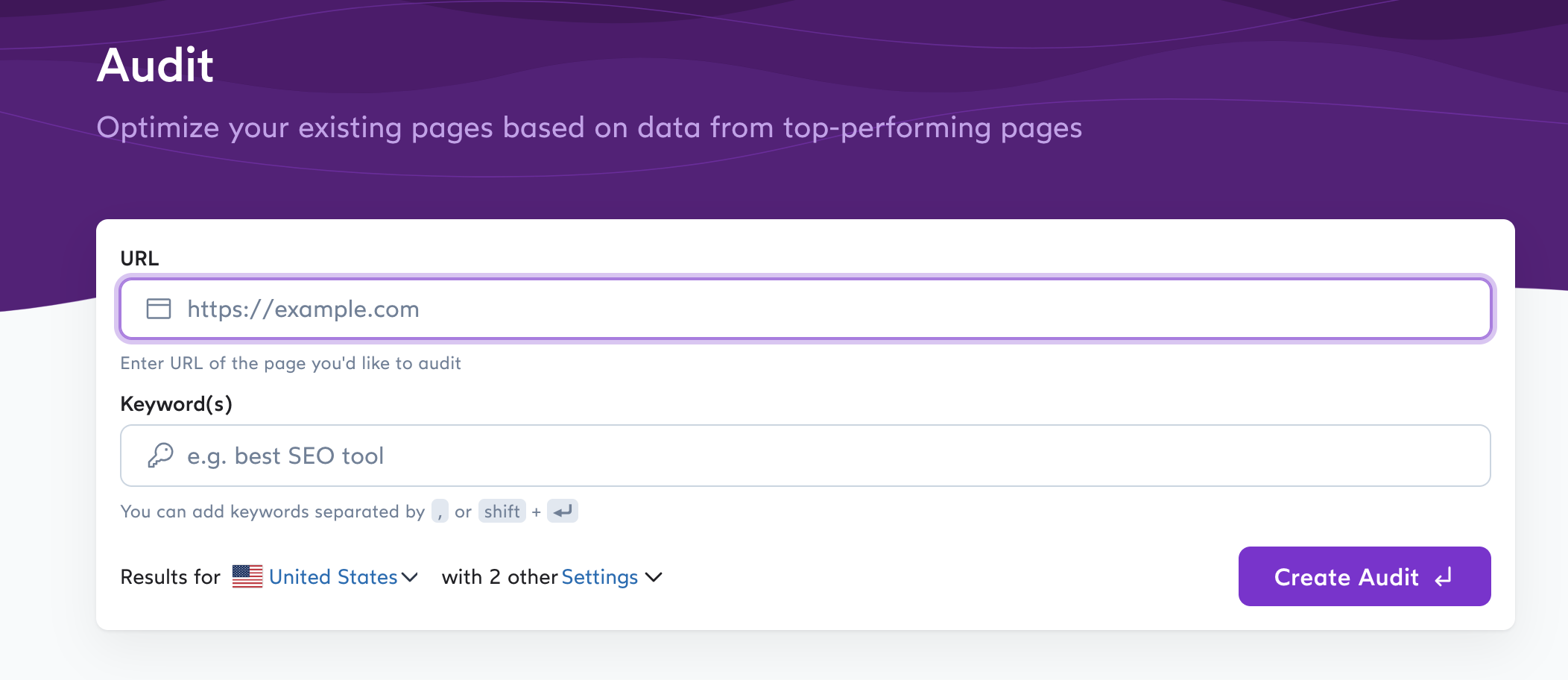
Audit tool
The audit tool lets you run an audit of a page of your choice. Here are the steps.- Open Audit
- Type in the URL you want to optimize
- Type in your focus keyword and click “Run Audit with NLP.”
- Scroll down to the Internal links section
- Click show internal links to reveal missing links
- You can export the list in .csv file
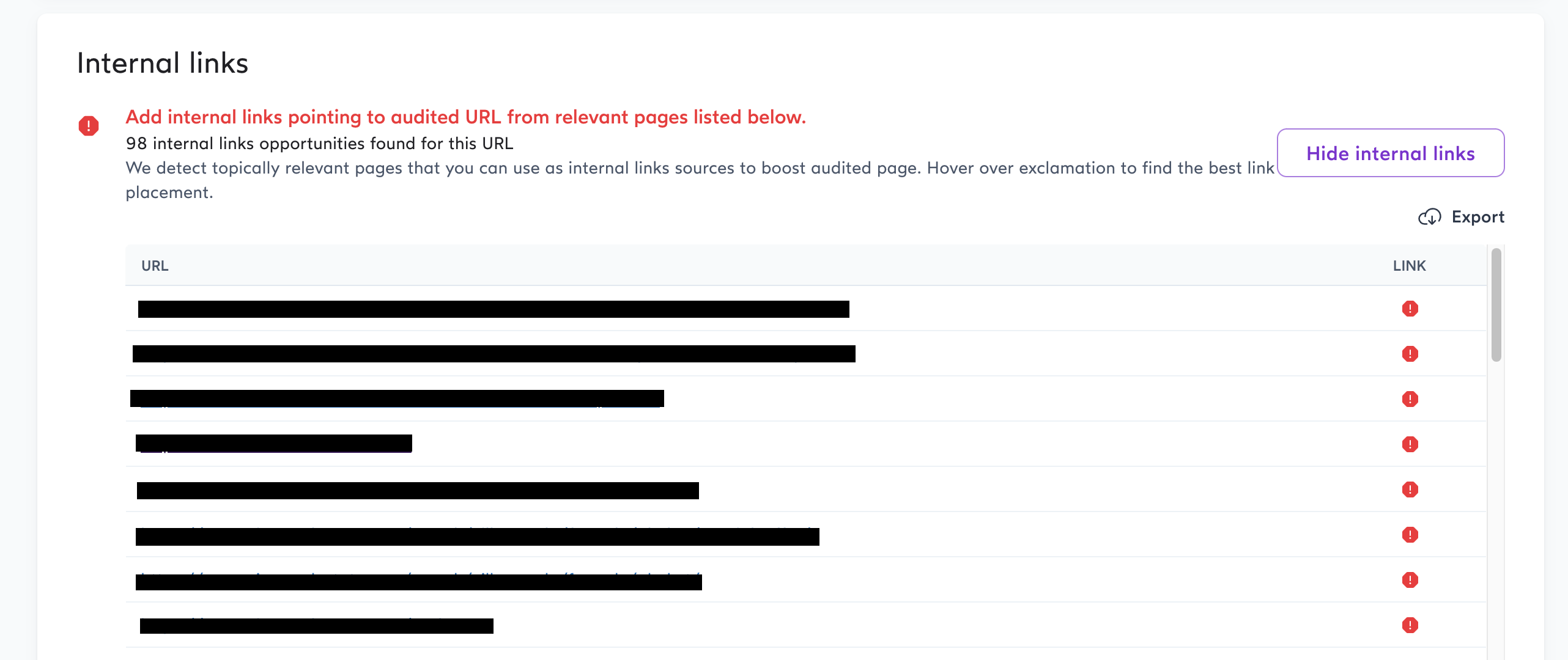
This section gives a full rundown of all the links your article should have for the best experience.
The best way to go about it is to start from the top and work your way to the bottom.
The links are ordered by relevance hence it is strongly advised to follow that order.
How important is anchor text in links?
This is a tricky concept.Some tend to think that anchor text is counted in word density but the reality is that it's not.
Let's take a logical approach.
If you are writing an article about soundproofing your house but also give advice on how to install double glazed windows, would you want that keyword to count in keyword density?
Definitely not.
After all, you want to help your reader with a very specific topic.
Hence, the Content Score in Surfer does not take into account anchor text.
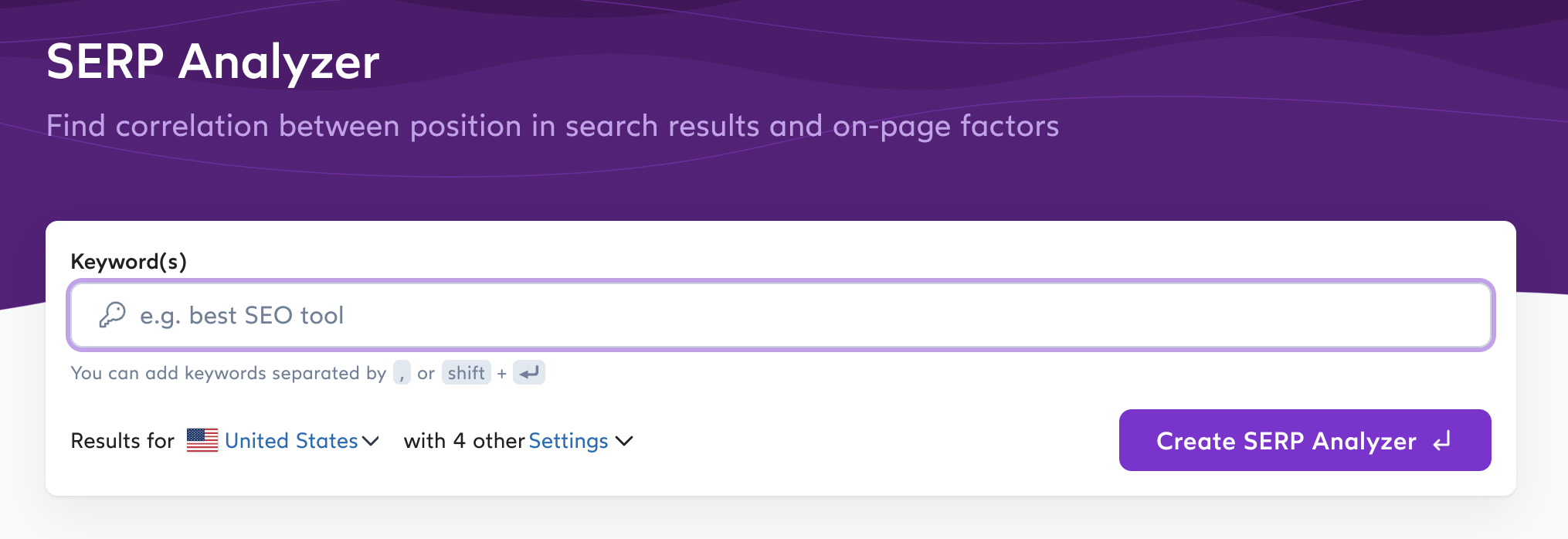
Find The Perfect Anchor Text With SERP Analyzer
- Go to SERP Analyzer and type in your target keyword
- Click the Keywords tab
- The top 10 keywords are the best anchor text opportunities
The keywords are sorted by relevance so you should organize them accordingly.
This tells you that if you link to a page with a keyword suggested by SERP Analyzer it is more likely to rank for that keyword.
In turn, this will create a topical cluster which helps to rank your original page in the end.
This solidifies a good user experience and makes it bot-friendly as well. In essence, a well designed internal linking strategy will help you rank for more keywords and improve your SEO in the long run.
Fix over optimized anchor text
Over optimized anchor text is a very common issue with a lot of websites.If you are building pages at scale it is oftentimes easy to get lost in choosing the perfect anchor text.
But here's the good news, you don't need to be a rocket scientist to figure it out.
It's an art in itself.
Just ask yourself, does this anchor text lead me to a place where I really want to go?
Is it descriptive enough to tell me exactly what I'm going to get? Does it match the title of the target page? Is the article relevant to what I'm reading now?
If you answered "no" to at least one of those then you might want to put in a little bit of extra time in your anchor text selection.
Just think how would you feel if you clicked on a link and suddenly you ended up on a page that's about something totally unrelated to what you're reading. That's a no go.
Including at least one of your keywords in the anchor text can be a good rule of thumb to follow.
Make sure you don't overuse it and you will be good. Make variations, get creative. Google will love you for that and the users will have a better all around experience too.
In the end everybody wins.
Create Topical Authority With Content Planner
Running out of ideas for content? Well, Surfer SEO has a solution for that.
The Content Planner allows you to create topic clusters and effectively build up a your authority.
How to establish topical authority?
Create topical clusters that thoroughly cover the topic of your website.
If you have a website about CBD you will want to cover not only the reviews of the best CBD oils, gummies and topicals, etc.
Ideally, you want to talk about other related topics such as how to make CBD oil at home, how to verify the purity of your product, what to avoid when buying CBD products, etc.
The Content Planner will help you create individual topic clusters that will effectively build your domain's topical authority.
And this is what Google truly loves now - authority.
Websites that fully cover a specific topic will rank high for multiple keywords high in the SERPs.
How To Create Topic Clusters With Surfer SEO
- Go to Content Planner
- Type your main keyword
- Click Create Content Planner
Your main keyword should be somewhat broad and not too specific. You may want to target it later so keep that in mind.
Some examples for Content Planner may include: cars, bathroom, garden, survival, sleep, etc.
After Surfer is done you will get a list of topic clusters with guidelines.
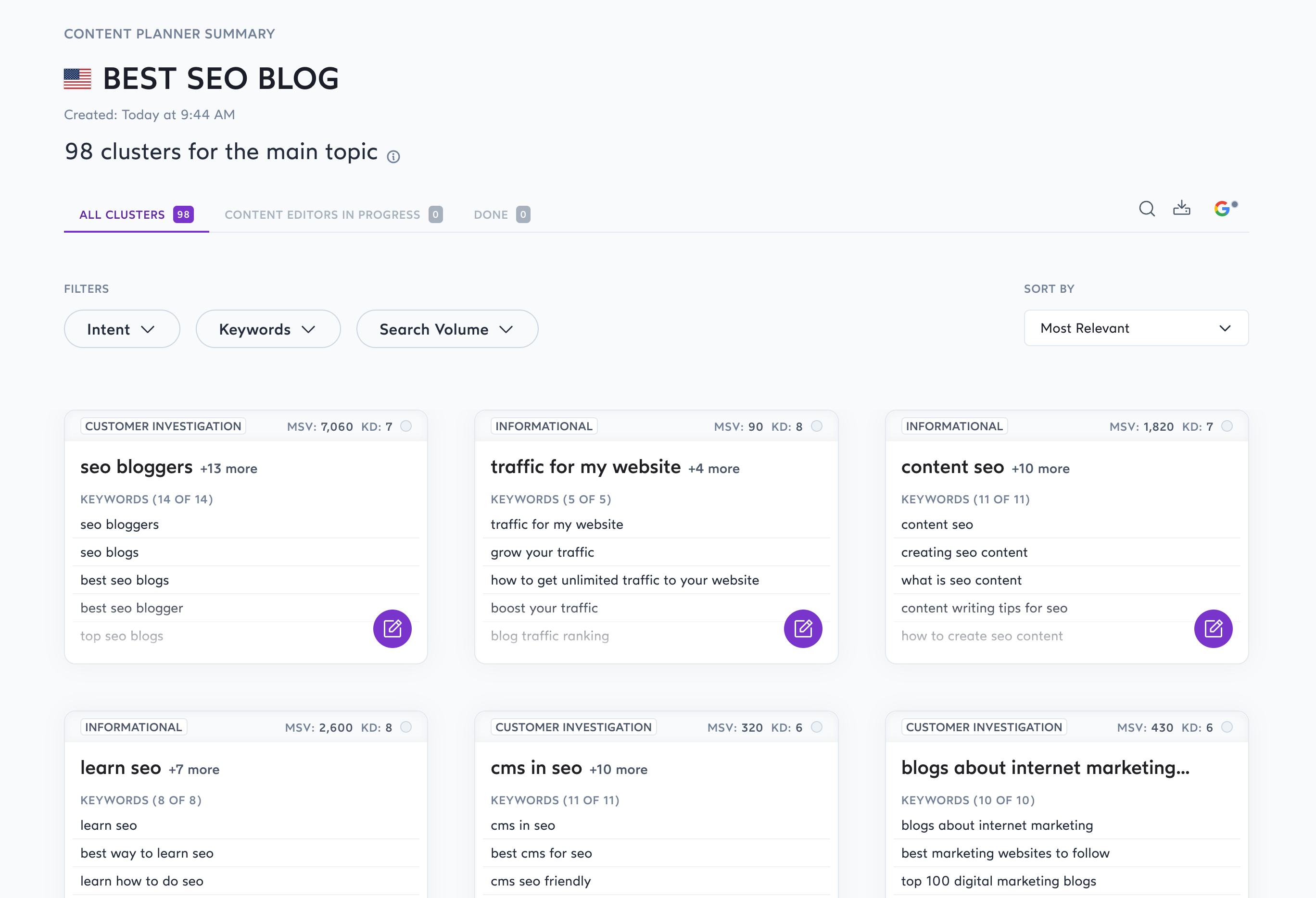
Each box is nothing but a topic cluster and comes with a list of keywords that you can use in your article.
Keep in mind that each cluster has a different intent behind it and is meant for a different search result.
Here's a list of different intent from an SEO perspective:
- Informational - educational content that goes deep into a specific topic in a long-form blog post
- Commercial - comparisons of different products, services, listings, etc
- Local - usually service providers in your local area (service pages or landing pages)
- Buying - e-commerce type category pages such as single product pages
From here you can use these topic clusters to create Content Editors for each of your target keywords.
What We've Learned
Every year Google releases new updates. Google search is getting more intricate with NLP algorithms understanding our needs better and producing relevant results faster than ever.Google is not slowing down. As a matter of fact, the Google bots are getting smarter when scanning your website immediately detecting "unfriendly" environments and turning back as a clear signal goes off.
That means they will consider your website less worthy to the user and consequently limit its visibility in search engines.
You can stop that from happening by designing digital marketing strategy with user intent in mind. As long as you write naturally and provide value (no keyword stuffing) that genuinely helps the user you will come out on top.
Whenever you decide to link out to a page and that link leads to a relevant resource your SEO scores will most likely improve.
Excellent navigation is the foundation for successful SEO solutions.
Google is doubling down on figuring out what the users really need because that's where the money comes from.
So clever SEOs will check all the ranking factors and make sure their websites are free of dead ends and irrelevant linking structures.
Using Google's algorithm with machine learning and Natural Language Processing (NLP) you can get a better feel for the sentiment of each page using the built-in sentiment analysis.
This is really helpful when trying to help your users as best as possible.
It's all a matter of making it easy and accessible to the user.
Surfer SEO is a tool that removes a lot of the guesswork associated with creating the perfect article.
Having the abundance of keyword data available at your fingertips makes the process a whole lot easier.
Just from the Content Editor itself you can get a really good feel for the tone and supporting topics the people are interested in.
In addition, this data is constantly updated in real time. This makes it easier than ever to keep your content fresh and relevant.






 Download