



There is a massive difference between "SEO traffic" and "SEO revenue."
You can rank #1 for a blog post about "how to tie shoes" and get 50,000 visitors, yet make zero dollars. Conversely, you can rank #1 for "buy waterproof hiking boots size 10" and make a fortune with just 50 visitors.
Many store owners chase vanity metrics. They want more clicks. But if you want to increase ecommerce seo revenue, you need to stop optimizing for volume and start optimizing for value.
This guide covers the 5 specific SEO adjustments that turn organic traffic into actual cash in the bank.
Revenue SEO: The Cheat Sheet
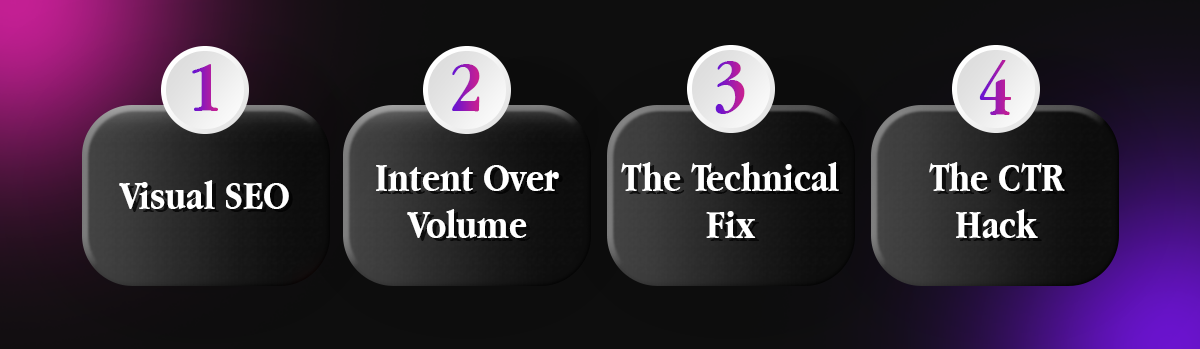
Here is the fast track to monetization:
- Visual SEO: Google Images is a shopping engine. Descriptive filenames drive sales.
- Intent Over Volume: Ranking #1 for a specific 3+ word phrase earns more than ranking #10 for a generic term.
- The Technical Fix: Canonical tags are mandatory to stop product variants from diluting your ranking power.
- The CTR Hack: Star ratings and price snippets make your listing impossible to ignore.
On This Page
- Way 1: Image Optimization (The "Visual SEO" Revenue)
- Way 2: Target "Money" Keywords (Long Tail Strategy)
- Way 3: The "Duplicate Content" Fix (Canonical Tags)
- Way 4: Leverage "Rich Snippets" for CTR
- Way 5: Strategic Internal Linking (Link Equity Flow)
- Summary of Revenue Impact
- eCommerce Revenue FAQ
- The Strategic Bottom Line
Way 1: Image Optimization (The "Visual SEO" Revenue)
Most store owners upload images and forget about them. This is a mistake because Google Images is a massive source of visual shopping traffic.
Descriptive Filenames
Stop using default names like IMG1234.jpg. You must rename every product image to match what users actually search for.
- Bad: DSC_001.jpg
- Good: lavender-scented-soy-candle.jpg
Alt Text
Add descriptive "Alt Text" to every image. This serves accessibility purposes but also tells Google exactly what the product is. This helps you rank for specific visual queries when a user switches to the "Images" tab to find a product style they like.
Way 2: Target "Money" Keywords (Long Tail Strategy)
Don't chase generic terms like "candles." That market is too crowded.
High Intent vs High Volume
You need to target specific 3+ word phrases like "scented soy candles for relaxation."
The Conversion Gap
These users know exactly what they want and are ready to buy. Ranking #1 for a specific term often yields significantly more revenue than ranking #10 for a generic one. The traffic volume is lower, but the conversion rate is exponentially higher.
Way 3: The "Duplicate Content" Fix (Canonical Tags)
Duplicate content is a revenue killer.
Unique Narratives
Manufacturer descriptions are dangerous because everyone uses them. If you copy paste from your supplier, Google hides your page. You must write unique, benefit driven descriptions for every product.
Canonical Strategy
If a product has 10 variations (colors/sizes), it creates 10 different URLs. This dilutes your SEO power. Use canonical tags to tell Google which one is the "master" page. This concentrates all your ranking power into one strong URL instead of spreading it thin across 10 weak ones.
Way 4: Leverage "Rich Snippets" for CTR
You do not always need to rank higher to get more traffic. You just need to take up more space.
Schema Markup
Add code to your site that displays price, availability, and star ratings directly in search results.
Visual Dominance
These "rich snippets" make your listing larger and more trustworthy. A user seeing "⭐⭐⭐⭐⭐ In Stock" is far more likely to click your link than a plain competitor's link. This increases your Click Through Rate (CTR) instantly.
Way 5: Strategic Internal Linking (Link Equity Flow)
Your product pages are often hard to link to directly. You need to use your blog to power them up.
Cross Pollination
Don't let blog traffic go to waste. In every blog post (e.g., "Best Candles for Home"), link directly to the specific product pages mentioned in the text.
Authority Transfer
This passes the "authority" of your helpful content directly to your sales pages. It signals to Google that your product pages are important, boosting their ranking for commercial keywords.
Summary of Revenue Impact
| Strategy | Revenue Impact
| Implementation Focus |
| Image SEO
| High (Visual Search Traffic)
| Filenames & Alt Text |
| Long Tail Keywords | High (Ready to Buy Users) | Specific Phrases (3+ words) |
| Canonical Tags
| Medium (Saves Ranking Power) | Technical Setup |
| Schema Markup | High (Increases Clicks) | Code/Plugins |
| Internal Linking
| Medium (Boosts Sales Pages)
| Content Strategy |
Need a Revenue Focused Audit?
Increasing revenue requires a different mindset than increasing traffic. You need technical precision to fix leaks and strategic insight to target buyers.
On Legiit, you can find eCommerce SEO experts who focus on ROI. They can audit your schema, fix your canonical tags, and restructure your internal links to maximize your bottom line.
eCommerce Revenue FAQ
What is the 80 20 rule of SEO?
The 80 20 rule (Pareto Principle) in SEO implies that 80% of your results come from 20% of your efforts. For ecommerce, the vital "20%" is usually fixing technical errors (like duplicate content) and targeting high intent long tail keywords.
How to improve SEO of an ECommerce website?
Improving ecommerce SEO requires a mix of technical, content, and authority work. You must optimize your site structure (flat URLs), fix technical errors (canonical tags), create unique product descriptions, and build high quality backlinks to your category pages.
What are the 4 pillars of SEO?
The 4 pillars are Technical SEO (site speed, mobile friendliness), On Page SEO (content, keywords), Off Page SEO (backlinks, authority), and Content (quality, relevance). You need all four to rank successfully.
What are the 5 C's of eCommerce?
The 5 C's are Company (your brand), Collaborators (suppliers), Customers (target audience), Competitors (market analysis), and Context (macro environment). Understanding these helps you build a better SEO strategy that aligns with business goals.
What are the 4 types of SEO?
The four main types are White Hat SEO (following rules), Black Hat SEO (breaking rules), Grey Hat SEO (a mix), and Negative SEO (attacking competitors). For a sustainable business, always focus on White Hat strategies.
The Strategic Bottom Line
If you want to increase ecommerce seo revenue, stop obsessing over vanity metrics like "total pageviews."
Start obsessing over Intent and Conversion.
By fixing your image data, adding rich snippets, and targeting long tail keywords that signal a desire to buy, you transform your SEO strategy from a traffic hose into a revenue engine.







 Download