

For decades, business leaders drove their companies while looking in the rearview mirror. They waited for the end of the quarter, looked at the sales reports, and then tried to figure out what to do next. If sales were down, they reacted. If churn was up, they panicked.
This reactive approach is no longer sustainable.
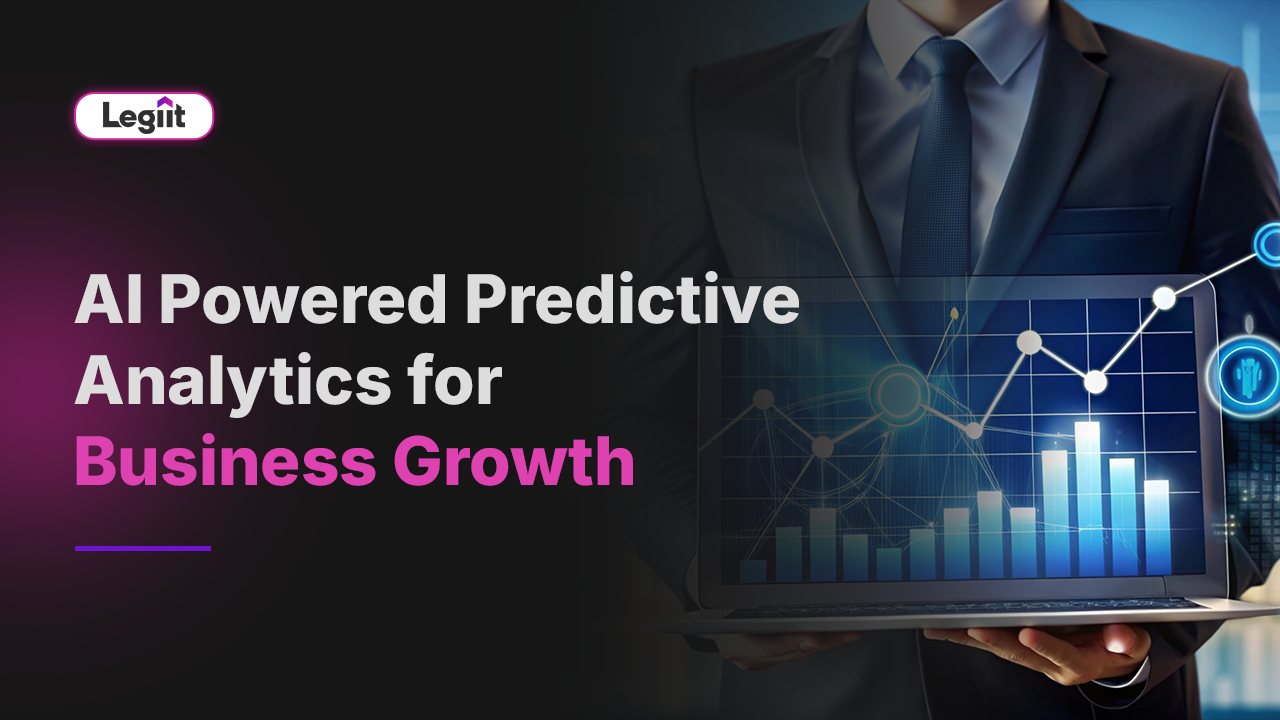
In 2026, the winners are not the ones who react the fastest; they are the ones who predict the future before it happens. This is the promise of AI Powered Predictive Analytics. It transforms your data from a static history book into a dynamic crystal ball.
Instead of asking "What happened last month?", predictive analytics allows you to ask "What will happen next week?" and "Which customer is about to leave us?"
This guide explores how this technology works, why it is the engine of modern growth, and how you can move your business from hindsight to foresight.
From Hindsight to Foresight
To understand the power of predictive analytics, you have to understand the shift from traditional methods.
Most businesses still rely on Descriptive Analytics. This is the standard dashboard that shows you a line graph of past revenue. It is useful for keeping score, but it is useless for changing the outcome of a game that has already been played.
Predictive Analytics uses historical data to train machine learning models. These models find hidden patterns that no human could spot. They look at variables like seasonality, customer browsing behaviour, and economic indicators to calculate the probability of future events.
It gives you a confidence score. It might tell you, "There is an 85 per cent chance that inventory for Product X will run out in 12 days." This gives you almost two weeks to fix a problem that hasn't even happened yet.
The Engine of Growth: Three Key Use Cases

Predictive analytics is not just for Wall Street traders. It is a practical tool for growing businesses in almost every sector.
1. Crushing Customer Churn
Acquiring a new customer is five times more expensive than keeping an old one. Yet, most businesses do not know a customer is unhappy until they cancel.
AI changes this. By analysing "pre-churn signals", like a drop in login frequency, an increase in support tickets, or a delay in bill payment, an AI model can flag high risk customers weeks before they leave. This allows your team to reach out with a special offer or a check in call, saving the relationship and the revenue.
2. Inventory Forecasting
Overstocking kills cash flow. Understocking kills sales.
Traditional forecasting relies on simple averages. "We sold 100 units last December, so let's order 100 this year." AI goes deeper. It looks at weather forecasts, local events, and current social media trends. If a blizzard is predicted for Chicago, the AI knows to increase stock of winter coats in that specific warehouse, preventing lost sales.
3. Dynamic Pricing
You see this every time you book a flight, but now it is available for ecommerce and services. AI models analyse competitor pricing and demand surges in real time. If demand spikes, the AI can slightly raise prices to maximise margin. If demand softens, it can deploy a targeted discount to keep volume moving.
The Data Quality Reality Check
There is a catch. AI is not magic; it is math. It relies entirely on the quality of your data.
If your data is messy, if you have duplicate customer records, missing fields, or unconnected silos, the AI will make bad predictions. This is known as "Garbage In, Garbage Out."
Before you can build a predictive engine, you need a robust data infrastructure. You need to connect your CRM, your website analytics, and your financial software into a single, clean source of truth. This is often the hardest part of the project, but it is the foundation for everything else.
Why You Need a Human in the Loop

It is tempting to think you can just turn on an AI and let it run your company. This is a mistake.
Predictive analytics deals in probabilities, not certainties. It might tell you a customer is a fraud risk, but it could be wrong. If you automatically block that customer without human review, you lose legitimate business.
The best systems use a "Human in the Loop" workflow. The AI acts as a radar, scanning the horizon and flagging potential risks or opportunities. The human then acts as the pilot, deciding whether to trust the radar and take action.
Why Off the Shelf Tools Fall Short
Many generic software tools claim to have "built in AI features." Usually, these are very basic. They might give you a simple trend line, but they do not understand the nuance of your specific business model.
To get true predictive power, the kind that gives you a competitive moat, you often need a custom solution. You need a model trained on your specific customer data, not a generic industry average.
This brings us back to our pillar resource: The Top 10 Freelancers who build AI Analytics Dashboard for Business Intelligence. These are the data scientists and engineers who can build the custom models you need. They can clean your data, train the AI, and build the dashboards that turn complex probabilities into simple, actionable insights.
Final Verdict
The era of guessing is over.
If you are still making decisions based on gut feeling or last month's spreadsheet, you are operating with a blindfold on. Your competitors are already using AI to see around corners.
Predictive analytics is the ultimate leverage. It allows a small team to operate with the intelligence of a giant corporation. It helps you save customers before they leave and stock products before they trend.
But remember, the software is only as good as the builder. A bad model is worse than no model.
To get this right, you need a partner who understands the math and the business logic. Head to Legiit, browse the experts in AI Analytics, and find a freelancer who can build you a dashboard that looks forward, not backwards.
FAQ: AI Predictive Analytics
What is the difference between predictive and prescriptive analytics?
Predictive analytics tells you what might happen (e.g., "Sales will drop 10%"). Prescriptive analytics goes one step further and tells you what to do about it (e.g., "Run a 15% discount campaign on Tuesday to offset the drop").
Do I need a lot of data to start?
Yes, but less than you think. You do not need "Big Data" in the billions of rows. However, you generally need at least 12 to 24 months of historical data so the AI can learn seasonal patterns and trends.
Can AI predict the future with 100 percent accuracy?
No. No system can predict the future perfectly. AI provides probabilities. It might say "There is a 90% chance of rain," but it can still be sunny. It is a tool for risk reduction, not fortune telling.
Is predictive analytics only for large enterprises?
Not anymore. With the rise of cloud computing and open source AI models, small and mid sized businesses can now afford to build predictive engines that used to cost millions of dollars.
How long does it take to build a predictive model?
A basic model can often be built in a few weeks. However, "tuning" the model to be highly accurate can take a few months of testing and refinement.







 Download