

Search for "SEO services" and within minutes, you're drowning in options. Keyword research. Technical audits. Link building. Local SEO. On-page optimization. Content strategy. Every agency and freelancer packages these differently, prices them differently, and talks about them like they're the most important thing you could possibly buy.
Most small business owners I talk to are stuck in the same place: they know SEO matters, but they have no idea what to actually buy or where to start. So they either spend money on the wrong things, or they don't spend at all and wonder why they're not ranking.
This guide cuts through that. Each section covers one core SEO service category: what it actually does, what a real deliverable looks like, and which businesses should prioritize it. Organic search drives 53% of all website traffic, more than paid ads, social, and email combined. Getting your SEO mix right is worth the time.
What Are SEO Services? A Quick Overview
SEO services are activities carried out to improve how often and how prominently your website appears in organic search results. They fall into three broad categories: on-page SEO (what's on your site), off-page SEO (who's linking to it), and technical SEO (how well it's built and indexed). Think of these as three legs of a stool. Weaken any one of them and the whole thing wobbles.
Some businesses handle pieces of this in-house; others hire an agency; others use a marketplace like Legiit to build a custom mix of freelancers for each service type. There's no single right approach. Just the one that matches your budget, goals, and how much you want to manage yourself.
The rest of this guide maps to those three pillars, plus analytics, competitor research, and local SEO, which have their own distinct logic.
1. Keyword Research and Strategy
Keyword research is the one service you can't skip, because everything else builds on it. Optimize the wrong pages, target the wrong terms, and all the money you spend on content or link building is working against you from the start.
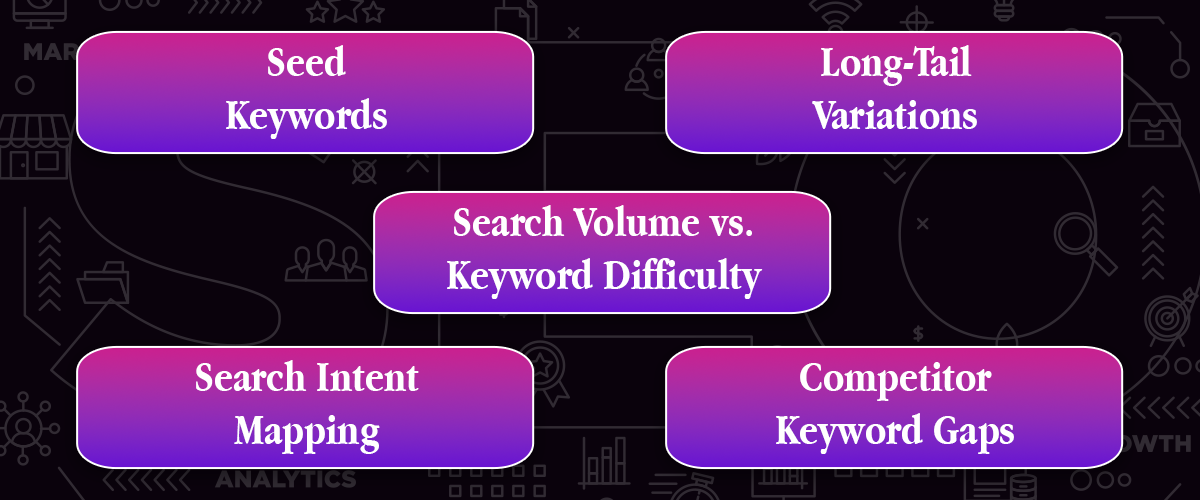
A solid keyword research deliverable isn't just a spreadsheet of terms with search volume. It should include seed keywords and long-tail variations, search intent mapping, competitor keyword gaps you can fill, and a clear priority order for which terms to go after first.
The intent piece is where most people go wrong. Take two keywords: "what is email marketing software" vs. "best email marketing software for ecommerce." Both might have similar search volume, but one is searched by someone who has no idea what they need yet, and the other is searched by someone ready to evaluate options and potentially buy. If you're running an ecommerce email tool, chasing the first keyword wastes your budget. You get traffic, but not customers.
We see this pattern constantly in outreach campaigns at Hunter. Prospects who found us through high-intent keywords like "find email addresses for outreach" convert at a dramatically higher rate than those who landed through informational queries. The traffic numbers look similar in analytics; the revenue impact is not.
For a deeper breakdown of how to identify searches that actually convert, Legiit's guide to buyer intent keywords is a good starting point.
2. On-Page SEO Optimization
On-page SEO is the fastest win available to most businesses, because you already own the content and just need to make it work harder.
The core elements of on-page SEO:
- Title tags: the clickable headline in search results; the single strongest on-page ranking signal
- Meta descriptions: don't directly affect rankings, but a well-written meta description improves click-through rate from the SERP
- Header structure (H1, H2, H3): tells both users and crawlers how the page is organized
- URL structure: clean, keyword-containing URLs that describe the page content
- Internal linking: passes link equity between your pages and helps users navigate
- Image alt text: helps with accessibility and image search visibility
- Schema markup: structured data that unlocks rich results (star ratings, FAQs, event details)
According to Backlinko's analysis of search results, pages with target keywords in their URLs see a 45% higher click-through rate than pages without. That's a meaningful difference for something that takes five minutes to fix on an existing page.
Beyond the technical elements, content optimization matters just as much. That means reviewing existing pages against the search intent of their target keyword, tightening the copy, improving readability, and making sure each page has one clear job. A page trying to rank for three different keywords usually ranks well for none of them.
My honest take: if your site has been live for more than a year and has never had a systematic on-page review, this is where I'd spend the first month's budget. The improvements are often significant and fast, because you're not waiting for Google to discover new content. You're fixing pages that already have some authority.
3. Technical SEO
Technical SEO is the foundation. A technically broken site undermines everything else you're doing: content, links, all of it.
Here's a real example of how badly this can go: a SaaS company I know was investing $5,000/month in content and link building for over a year with almost no organic growth. When we finally looked under the hood, their entire blog had been accidentally noindexed after a CMS migration. Not a single blog post was being indexed by Google. Every dollar spent on content during that period was wasted.
That's an extreme case, but technical issues quietly kill SEO performance all the time. The main areas that technical SEO covers:
- Site speed and Core Web Vitals: Google uses page experience as a ranking factor, and slow sites lose visitors fast. Nearly 63% of Google's US organic traffic comes from mobile, where speed matters even more
- Crawlability and indexation: are your important pages actually being indexed? Are crawl errors blocking key content?
- Mobile-friendliness: a site that breaks on a phone isn't just bad UX. It's a rankings problem
- XML sitemaps: a roadmap that tells search engines which pages exist and how they're organized
- Canonical tags: prevent duplicate content from splitting your ranking signals across multiple URLs
- HTTPS: a baseline trust signal; sites without SSL certificates get warned in browsers and rank worse
The right starting point is always a technical SEO audit. An audit surfaces what's broken, what's missing, and what's slowing things down, before you spend money fixing things in the wrong order.
Prioritize technical SEO if your site is more than two years old and has never had a proper audit, if you've recently migrated to a new platform, or if pages are disappearing from rankings without an obvious reason.
4. Content Creation and Content Marketing

Content is the primary driver of organic traffic at scale, but only when it's built around specific search intent, not just topics that seem interesting.
The most underused content strategy isn't publishing more. It's refreshing what you already have. Most sites have a graveyard of articles that ranked on page two or three at some point and have since slipped. Those pages already have some authority. They just need to be updated, expanded, and re-optimized to compete again. Updating an existing blog post can lead to as much as 146% growth in search traffic, according to aggregated data from Semrush and Ahrefs.
At Hunter, we've seen this play out directly. A post on cold email subject lines had been sitting at position 8–12 for months. We updated the data, added new examples, improved the structure, and added a comparison table. Within six weeks it was ranking in the top three. No new links. No major structural change. Just better content on a page that already had traction.
Content marketing as an SEO service typically includes:
- Topic ideation mapped to keyword research and search intent
- Content briefs that specify structure, target keyword, and what the piece needs to cover to outrank competitors
- Writing (blog posts, landing pages, pillar pages, product descriptions)
- On-page optimization before publishing
- Content refresh and update services for older posts that have dropped in rankings
One thing to be clear about: publishing content without a keyword target isn't a strategy. "We should write about X because it's relevant to our audience" is not enough. Every piece needs a specific search query it's trying to win.
5. Link Building and Off-Page SEO
Backlinks remain one of Google's strongest ranking signals, and the gap between sites that invest in link building and those that don't is measurable and significant.
A Backlinko study of 11.8 million Google search results found that the number-one result has an average of 3.8 times more backlinks than positions two through ten. That's not a marginal difference. For competitive keywords, it's often the deciding factor between ranking on page one and not ranking at all.
The main link building service types:
- Guest posting: writing content for another site in exchange for a contextual link back to yours
- Digital PR: earning links through original research, data studies, or press-worthy stories
- Broken link building: finding dead links on relevant sites and offering your content as a replacement
- Resource page outreach: getting listed on curated resource pages in your niche
- HARO/journalist outreach: responding to journalist requests for expert quotes, earning links from high-authority news sites
When evaluating a link building provider, the only metric that matters is relevance. A link from a genuinely relevant site in your industry is worth more than ten links from unrelated blogs, even if those blogs have higher domain ratings. Look for editorial placements (meaning the link is embedded in real content, not a footer, sidebar, or paid directory).
Before scaling any link building effort, it's worth getting clear on how to structure a link building strategy so you're building toward the right targets.
Red flags: Private blog networks (PBNs), link farms, and anyone promising "guaranteed placements" from a fixed list of sites. These can show short-term results and cause long-term, hard-to-recover-from penalties.
The Outreach Step Most Businesses Skip
The biggest bottleneck in link building isn't the pitch. It's finding the right person to send it to.
Most outreach fails because it lands in a generic inbox (info@, contact@, or the wrong team entirely). The email never reaches the person who decides on content and links. Hunter solves this directly: paste a target domain and you get a verified list of email addresses for the editors, content managers, and marketing leads who actually run the site. Each address includes a confidence score, so you can prioritize the strongest contacts.
The workflow that works:
- Build a list of target sites based on topical relevance and domain rating
- Run each domain through Hunter to find the right contact
- Verify the email before sending
- Send a personalized pitch that references something specific they've published recently
It's a small step that most people skip because it feels like admin. That's exactly why it works. Your pitch lands in the right inbox while your competitors' emails pile up unread.
6. Local SEO
For any business that serves customers in a specific geographic area, local SEO is the highest-ROI investment available. Full stop.
According to BrightLocal's research, 76% of consumers who search for something nearby visit a related business within a day. That's not traffic for its own sake. That's qualified intent converting into physical visits.
Local SEO works differently from general SEO. The ranking signals for Google's local map pack (the three results that appear above organic listings for local queries) include proximity, GBP completeness, review velocity, and NAP consistency across the web. None of those are factors in traditional SEO.
The core local SEO elements:
- Google Business Profile (GBP) optimization: categories, photos, business description, Q&A, posts, service areas, and attributes all affect map pack placement
- Citation building: your business name, address, and phone number need to be consistent across Yelp, TripAdvisor, and industry-specific directories, inconsistencies confuse Google and suppress local rankings
- Review acquisition: reviews are a direct ranking factor for local results, and the businesses that earn them systematically (post-service follow-up, automated reminders) consistently outrank those that don't
- Local keyword targeting: "plumber in Austin" and "emergency plumber near me" are different searches with different intent, your content strategy needs to account for both
The single most common mistake I see with GBP: businesses fill it out once when they claim the profile and never touch it again. Google actively rewards profiles that show ongoing activity. Recent photos, weekly posts, answered Q&As, these aren't optional extras. They're ranking signals.
Legiit's local SEO strategy guide covers the full setup process if you're starting from scratch.
7. SEO Analytics, Reporting, and Continuous Optimization
Monthly SEO reporting isn't just a status update. It's the mechanism that lets you adjust strategy before you've wasted three months going the wrong direction.
Without consistent reporting, you're flying blind. A keyword might be ranking well but generating zero conversions, which means your page needs a better call to action, not more backlinks. An article might have dropped from page one because a competitor published something more thorough, which means a content refresh, not a brand new post. These are completely different interventions, and you can only identify which one you need if you're tracking the data.
A proper SEO reporting setup tracks:
- Organic traffic trends by landing page, so you can see what's growing and what's stalling
- Keyword ranking changes week over week for your priority terms
- Conversion tracking from organic, traffic without conversion data is incomplete
- Backlink growth including new links earned, lost links, and domain rating changes
- Technical health via Google Search Console: crawl errors, indexation issues, Core Web Vitals
The essential tools: Google Search Console and Google Analytics are both free and non-negotiable. Add a paid rank tracker like Ahrefs or Semrush for keyword position data and backlink monitoring.
For teams running large-scale outreach or email-driven campaigns, monitoring domain health with tools like an SPF checker or domain verification tools can complement SEO efforts by protecting sender reputation.
One thing worth knowing going in: SEO results are slow to appear. Most campaigns take three to six months before rankings move meaningfully. Monthly reporting gives you the data to stay the course, or course-correct, rather than second-guessing the whole strategy at month two.
8. Competitor Analysis
Competitor SEO analysis answers the question that actually matters: not "how good is my SEO?" but "how good is my SEO relative to the people I'm trying to beat?"
Two sites can have identical on-page optimization and technical health, with completely different results, simply because one is competing in a market where the top-ranking pages have 400 backlinks per URL and the other is in a niche where you can rank with 20. You can't know which situation you're in without looking at what your competitors are actually doing.
Competitor analysis reveals: which keywords they rank for that you don't (gaps you can fill before they notice), where their backlinks are coming from (the same sites are often willing to link to multiple competitors), and which content formats are winning in your niche. That last point matters more than most people think. If every top-ranking competitor for a keyword has a detailed comparison guide and you're trying to rank with a product page, the format mismatch alone will hurt you.
This should be a recurring service, not a one-time report. The competitive landscape shifts. New competitors emerge, existing ones ramp up their content, and algorithm updates reshuffle rankings. Quarterly competitor analysis is enough to stay calibrated without overcomplicating the process.
How to Choose the Right SEO Services for Your Business
The right SEO mix isn't the same for every business. It depends on your stage, your competition level, and what's currently limiting your growth.
Here's how to think about it:
- New website or early-stage business: Start with keyword research and a technical audit. Publishing content before you know what you're targeting, or before your site is technically sound, means fixing twice as much work later. Get the foundation right first.
- Established site with thin or outdated content: On-page optimization and content refresh. You already have pages with some authority. Improving them is faster and cheaper than ranking new ones from scratch. A site with 50 mediocre posts will almost always outperform one with 200 thin ones.
- Local business: Local SEO is the priority, regardless of everything else. A well-optimized GBP and consistent citations will move the needle faster than anything else you can do. Start with a local SEO audit to find the gaps.
- Competitive niche with a mature site: Link building becomes the deciding factor. When your on-page and technical fundamentals are solid, the gap between you and the top results is almost always a backlink gap.
Budget Allocation Guide
| Budget Tier | Estimated Cost | Recommended Focus |
|---|---|---|
| Baseline | ~$500/month | Keyword research and on-page optimization on your five most important pages |
| Growth | ~$2,000/month | Add consistent content creation (two to four pieces per month) |
| Competitive | ~$5,000/month | Add link building, technical maintenance, and regular competitor monitoring |
If you're looking to build a custom SEO stack without committing to a full agency retainer, Legiit's marketplace lets you hire specialists for each service type independently. Keyword research from one person, link building from another, technical work from a third. You control the budget allocation and can scale each piece separately.
Start With the Fundamentals, Then Layer In the Rest
SEO is not one service. It's a set of interconnected services, and the order matters as much as the mix.
Start with the fundamentals: keyword research to know what you're targeting, a technical audit to fix what's broken, on-page optimization to make your existing pages work harder. Then add content creation, link building, and local SEO as your budget and results allow.
The businesses that get the most from SEO aren't the ones that try to do everything at once. They pick the right starting point, execute it well, and build from there.
Ready to find the right specialists? Explore SEO services on Legiit or run a free site audit to see where your biggest opportunities are.





 Download