


We often hear success stories that sound like magic. "We did X, and suddenly traffic exploded!" But real SEO is rarely that smooth. Before we cracked the code on Google's new AI Overviews (formerly SGE), we failed. Hard.
This is the story of how we took a client from complete AI invisibility to being the featured "Snapshot" source in just 30 days, but only after realizing that everything we thought we knew about ranking was wrong.
If you are a business owner watching your competitors appear in those big, shaded answer boxes at the top of Google while you are stuck down in the "blue links," this case study is for you.
What We Tried First (and Why It Failed)

Our client, a mid-sized B2B software company, was already ranking on Page 1 for their main keywords. We assumed getting into the AI Overview would be easy. We thought, "If Google likes us enough to rank us #3, surely the AI will cite us."
We were wrong.
The Mistake: We doubled down on "Traditional SEO."
- We added more keywords: We stuffed the articles with variations of the search terms.
- We made the content longer: We wrote 3,000-word "Ultimate Guides" thinking length equaled depth.
- We built more backlinks: We spent budget acquiring links from high-authority sites.
The Result: Zero change. The AI continued to cite a smaller competitor with a shorter, uglier website.
The Lesson: We realized that ranking algorithms and AI generation models are two different brains. The ranking algorithm looks for popularity (links). The AI model looks for extractability (clarity). Our content was too dense, too fluffy, and too hard for a robot to summarize.
The AI Decision Path: How the Machine Actually Thinks
To fix this, we had to stop thinking like marketers and start thinking like engineers. We mapped out how Google's Gemini AI processes a user's question. It doesn't just "read" a page; it dissects it.
Here is the flow we discovered:
Query → Intent → Entity Trust → Clarity → Citation
- Query: The user asks, "How to integrate CRM with accounting software?"
- Intent: The AI decides, "They want a step-by-step list, not a history of CRMs."
- Entity Trust: It scans for sources it recognizes as experts (not just popular sites).
- Clarity: This is where we were failing. The AI looks for clean data it can easily pull out.
- Citation: It builds the answer using the clearest source.
We realized our 3,000-word essays were confusing the AI. It couldn't find the "answer" buried in the fluff.
Why Google AI Chose Us Over Higher-Ranking Pages
Once we pivoted, the results were immediate. We didn't beat the competitors on domain authority; we beat them on communication.
Here is why the AI chose our client over giants like HubSpot or Salesforce for specific queries:
- Simpler Language: The big competitors used corporate jargon. We used simple, 8th-grade level English. The AI prefers sentences it doesn't have to decode.
- Better Formatting: We stopped writing walls of text. We used bullet points for every list and bold text for key definitions.
- Direct Answers: We stopped "burying the lead." If the header was "What is an API integration?", the very next sentence started with "An API integration is..."
We essentially spoon-fed the AI.
The 30-Day Timeline (Week by Week)
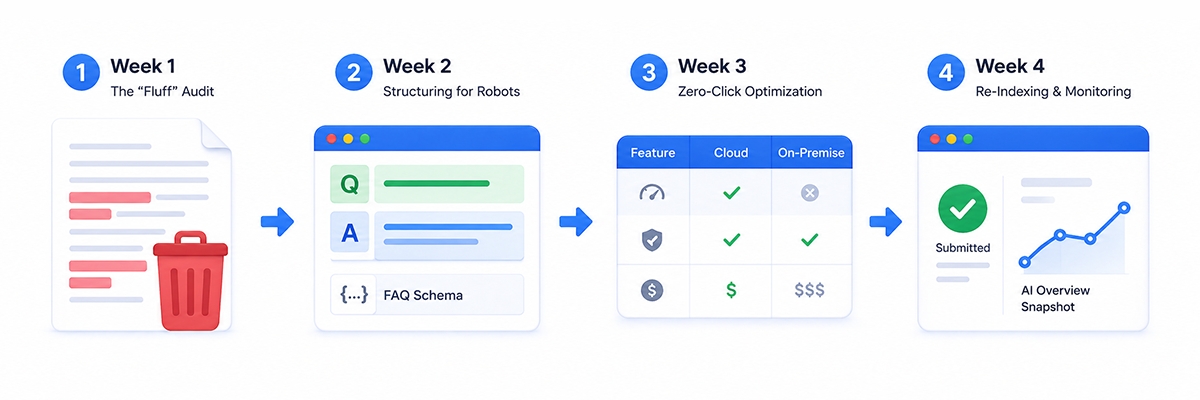
Here is the exact schedule we used to turn the ship around.
Week 1: The "Fluff" Audit
We ruthlessly cut content. We took their top 10 performing articles and deleted the long intros. We removed generic stock photos and "filler" paragraphs. We focused entirely on Information Gain—what new fact are we adding that isn't on Wikipedia?
Week 2: Structuring for Robots
We implemented the "Inverted Pyramid" style.
- Header: Specific Question (e.g., "Cost of CRM Implementation")
- First Sentence: Direct Answer (e.g., "The average cost is between $5,000 and $10,000.")
- Rest of Section: Nuance and details.
We also added FAQ Schema to the code, explicitly telling the AI, "Here is the question, and here is the answer."
Week 3: The "Zero-Click" Optimization
We accepted that some users wouldn't click. We created comparison tables (e.g., "Cloud vs. On-Premise") directly in the articles. We knew the AI would likely display these tables in the snapshot. This ensured that even if users stayed on Google, they saw our client's brand name as the source of the data.
Week 4: Re-Indexing and Monitoring
We manually submitted the updated URLs to Google Search Console. Within 5 days, we saw our first "Snapshot." The client's brand appeared in the AI Overview for their core term, driving highly qualified traffic.
What We Would Do Differently Next Time
Looking back, we wasted time in the beginning.
- What I’d Skip: I wouldn't waste time updating meta tags or old-school on-page SEO tweaks. The AI doesn't seem to care about title tags as much as the core content body.
- What I’d Do Earlier: I would implement "Author Profiles" immediately. We delayed adding detailed bios for the writers, but once we did, the "Entity Trust" signals seemed to spike.
- What Surprised Me: How fast it happened. Traditional SEO takes months. AI visibility can happen in days if the content structure is right.
The AI Overview Visibility Framework
If you want to replicate this, don't guess. Follow this framework:
- Intent-First Content: Answer the user's immediate question in the first sentence.
- Entity Reinforcement: Prove you are the expert (Author bios, about pages).
- Extractable Summaries: Use lists, tables, and bold text so the AI can "grab and go."
- Trust Proof: Cite real data and recent statistics.
- Continuous Prompt Testing: Constantly search your keywords to see what the AI is currently showing, and adapt your content to match that format.
FAQ: Getting Featured in AI Overviews
What is an AI Overview on Google?
An AI Overview is the AI-generated summary box that appears at the top of search results. It synthesizes information from multiple sources to give a direct answer to the user's query, often without them needing to click a link.
How does a person get an AI Overview?
You don't "get" one like you buy an ad. You earn it. You must optimize your web content so that Google's Gemini AI views it as the most trustworthy and clear answer to a specific question.
How to write content for AI Overview?
Write like a journalist, not a novelist. Use the "inverted pyramid" style: give the main answer first, then the details. Use short sentences, clear headings, and lots of bullet points. Avoid fluff and jargon.
How to get featured in AI Overviews?
Focus on "Information Gain." Provide unique data or expert angles that aren't found elsewhere. Structure your content with Schema markup so the AI understands it, and ensure your site loads fast on mobile.
Final Verdict
The game has changed from "Keywords" to "Communication."
Winning in AI Overviews isn't about tricking the system; it's about being the clearest, most helpful teacher in the room. If you make it easy for the AI to understand you, it will make it easy for users to find you.
However, executing this strategy, auditing for "fluff," implementing Schema code, and restructuring for "Information Gain" is time-consuming and technical.
You don't have to struggle through the trial and error like we did.
There are experts who have already mastered this new playbook. Check out our guide on the Top 8 Freelancers Who Can Get Your Business Ranking in AI Overviews (SGE). These specialists can skip the "failure" phase and go straight to building the strategy that gets you seen.








 Download